

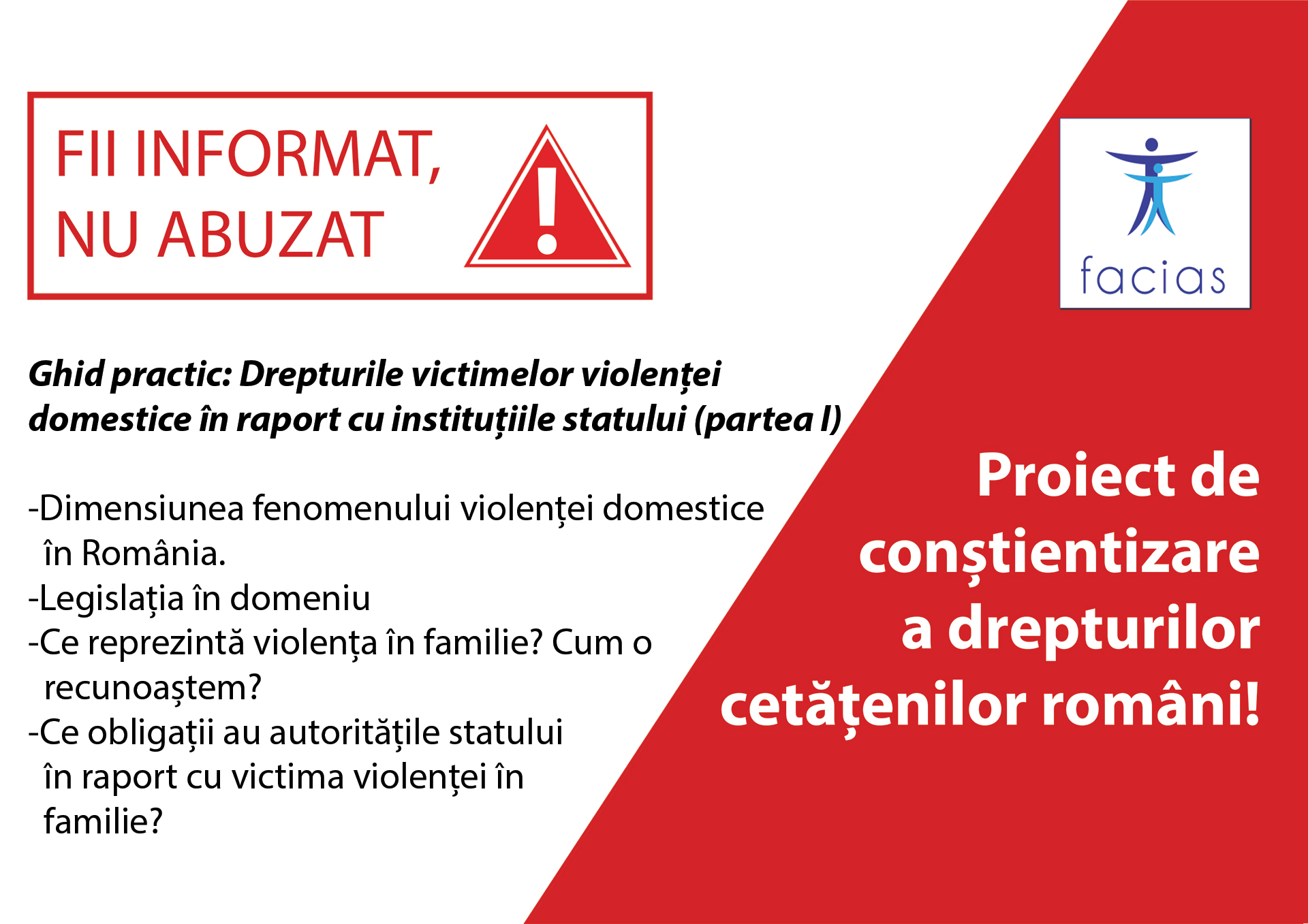
We start a new episode of the Practical Guide: rights, our tools in the fight against abuse, for the victims of domestic violence.
The phenomenon is of painful proportions in our country, unfortunately.
It does NOT solve itself. How many times have we been shaken by reports of how the victim of domestic violence ended up being killed, despite having lodged a complaint? We said then: the authorities didn't do their job.
This chapter will have four parts and will end in the first week of December.
Information on the rights of victims of domestic violence, specialist social services and what victims can do can also be obtained by calling the freephone number - 0800 500 333.
In this first part we will cover the following:
- The scale of the phenomenon
- Legislation in the field
- What is domestic violence? How do we recognise it?
- What obligations do the state authorities have towards the victim of domestic violence?
I.Domestic violence in Romania
Just to give you an overview, here are the data below:
First 7 months of 2020, domestic violence: 4,856 provisional protection orders in 7 months. 96% of perpetrators are men.
The number of victims is 5,431, of which 450 are men and 4,606 are women. Minor victims are 170 boys and 105 girls.
Protection orders (POs) issued in other years: 2017 - 2,894 POs, 2018 - 3,775 POs, 2019 (7 months) - 4,166 POs.
Below is the situation of domestic violence in the period 2016-2019,[1][1]
But only the reported situations, the real extent of the phenomenon is larger:

II. DEDICATED LEGISLATION
The legislation governing these rights of victims of domestic violence, including their rights in relation to state institutions, are largely laid down in laws (all of which, as we know, can be found on just.ro):
- Code of Criminal Procedure - rights of the injured party, the civil party and protective measures
- LAW No 678 of 21 November 2001
- LAW No 217 of 22 May 2003
- LAW No 211 of 27 May 2004
- What is domestic violence? How do we recognise it?
III.1. Families mean:
- a) ascendants and descendants, brothers and sisters, their children, as well as persons who have become by adoption according to the law (such relatives fall under the category of family);
- b) spouse and/or ex-spouse;
- c) persons who have established relationships similar to those between spouses or between parents and children, if they are cohabiting;
- d) the guardian or other person exercising rights in fact or in law in relation to the person of the child;
- e) the legal representative or other person caring for the person with a mental illness, intellectual disability or physical handicap, except for those performing these duties in the exercise of their professional duties.
III.2. Domestic violence manifests itself in the following forms (Article 4 of Law No 217/2003[2]):[2]):
- a) verbal violence - addressing through offensive, brutal language, such as the use of insults, threats, degrading or humiliating words and expressions;
- b) psychological violence - the imposition of will or personal control, the infliction of tension and mental distress in any way and by any means, demonstrative violence against objects and animals, by verbal threats, the ostentatious display of weapons, neglect, control of personal life, acts of jealousy, coercion of any kind, and other actions with similar effect;
- c) physical violence - bodily harm or injury to health by hitting, pushing, shoving, pulling hair, pricking, cutting, burning, strangulation, biting, in any form and of any intensity, including masquerading as the result of accidents, by poisoning, poisoning, and other actions having a similar effect;
- d) sexual violence - sexual assault, infliction of degrading acts, harassment, intimidation, manipulation, coercion into sexual relations, marital rape;
- e) economic violence - prohibition of work, deprivation of economic means, including deprivation of primary means of subsistence such as food, medicine, basic necessities, intentional taking of property, denial of the right to possess, use and dispose of common property, unfair control over common property and resources, refusal to support the family, imposition of heavy and harmful work to the detriment of health, including on a minor family member, and other actions having a similar effect;
- f) social violence - imposing isolation of the person from family, community and friends, prohibition to attend educational institution, imposing isolation through detention, including in the family home, intentional deprivation of access to information, and other actions with similar effect;
- g) spiritual violence - underestimating or diminishing the importance of meeting moral and spiritual needs by prohibiting, limiting, ridiculing, penalising family members' aspirations, access to cultural, ethnic, linguistic or religious values, enforcing adherence to unacceptable spiritual and religious beliefs and practices, and other actions having a similar effect or similar repercussions.
.
IV.What obligations do state authorities have towards the victim of domestic violence?
Central and local public authorities are obliged to inform victims of domestic violence about:
- institutions and non-governmental organisations providing psychological counselling or any other form of assistance and protection to the victim, depending on the victim's needs;
- the prosecution body to which they can lodge a complaint;
- the right to legal assistance and the institution to which they can turn to exercise this right;
- the conditions and procedure for granting free legal aid;
- the procedural rights of the injured person, the injured party and the civil party;
- the conditions and procedure for the award of financial compensation by the State, in accordance with the law. (http://prorefugiu.org/wp-content/uploads/2019/08/Financial-Compensation-Guide.pdf - page 6)
Next week, we will continue with more practical information showing what we, as victims of domestic violence, are doing to help victims of domestic violence.
[1] STRATEGY MONITORING REPORT -Domestic Violence - 2019, available at, diponibil la https://anes.gov.ro/wp-content/uploads/2020/07/Document.pdf .
Unfortunately, at the European level, regarding victims of violence against women https://eige.europa.eu/gender-statistics/dgs/indicator/genvio_phy_hom_adm__crâm_hom_soff__homsex_victperp ) , Romania has not provided data and is not included in European statistics on this chapter.
[2] Law 217/2003 for the prevention and
domestic violence, available free of charge at: http://legislatie.just.ro/Public/DetaliiDocument/44014