

Contents:
I.Background / Introduction
II. Treatment abroad. THROUGH THE MINISTRY OF HEALTH
II.2.1. What the document governing treatment abroad by the Ministry of Health says in brief
II.2.1. Ce spune, pe scurt, documentul care reglementează tratarea în afara țării, prin ministerul Sănătății
II.2.2 Practical steps
I. CONTEXT/INTRODUCTION
Last year, we partially addressed the issue of patients' rights in relation to state institutions and health care providers, through a material published on the FACIAS Project website "Be informed, not abused!", which you can see here: https://facias.ro/ghid-practic-pacienti-centrele-de-permanenta-arondate-fiecarui-judet/ , but also through several posts such as "Did you know...".
You can identify them quite easily by searching, on our facebook page #Pacient and #stiaica.
As our rights on health issues and access to health services have become a constant concern, the project team will dedicate 4-5 episodes to these topics which will be published every Wednesday, here.
It is necessary to know our rights in relation to the state and its institutions and when it comes to our health for which we contribute, monthly, 25% of our salary.
In previous episodes, we have dealt with more general issues:
- The most useful information needed: Insured's Guide;
- The legislation that secures our rights;
- Other sources of information.
- Practical guide: Patients' rights in relation to state institutions
- What do we do when we struggle with serious, rare diseases? Where do we find out about our rights?
- How do these programmes help us and where does the money for our treatments come from?
- How can we benefit from support through these programs?
- Treatment abroad, through a health insurance claim (part I): Form S2 (formerly E 112)
In this episode we will also talk about our rights in the field of health, when we cannot find salvation in our medical system, i.e. the right to be treated abroad (EU/EEA/Swiss Confederation/United Kingdom of Great Britain and Northern Ireland), when what we have cannot be treated in Romania, with costs borne by the National Health House. However, you should be aware that, in addition to this, there are also situations where we can be treated abroad (when we are in transit or for a period in a country, or when we work abroad on secondment), but we will deal with these only tangentially.
Treatment abroad, through a Health Insurance settlement (part III), this week includes two other possible options: through the Ministry of Health & through the European Directive 24.
If you want your insurer (the health insurance company) to pay the costs of your hospitalisation, you must obtain prior authorisation which entitles you to be treated under the same conditions and at the same price as the citizens of the state to which you are travelling for medical purposes. Otherwise, the sickness insurance fund may refuse your claim for reimbursement
When looking for a hospital in the EU that will provide the medical care you need, it is advisable to first contact your health insurance company. The health insurance company has the most information and can recommend a hospital, as the health insurers have special agreements with certain hospitals abroad.
I. THE INSTRUMENTS THAT ENSURE OUR RIGHT TO TREAT OURSELVES ABROAD
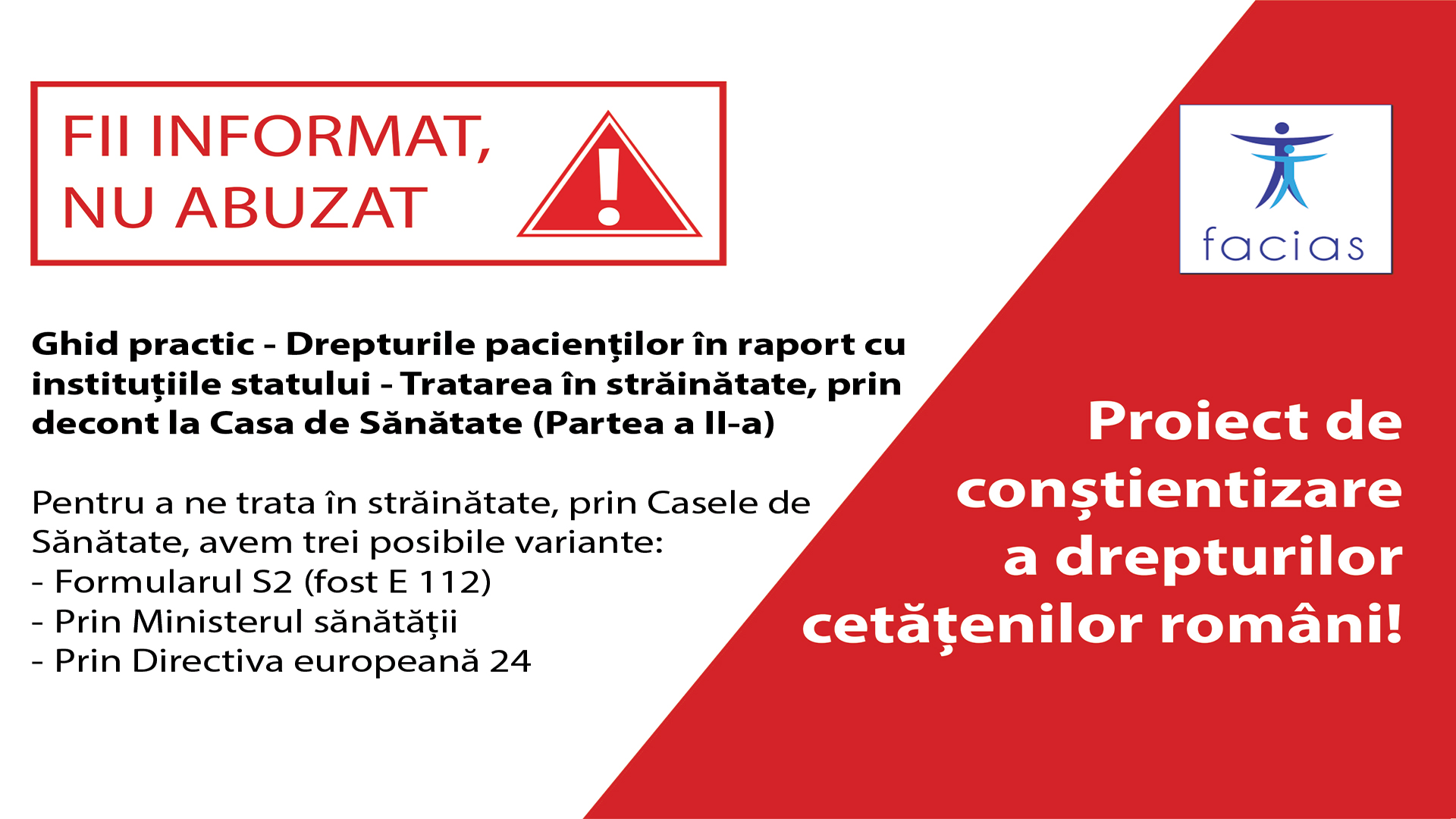
There are three possible options for treatment abroad through the health insurance companies:
Form S2 (formerly E 112)
Through the Ministry of Health
Through European Directive 24
We will take them one by one, but remember that you have the sources of information in this text available to you, precisely because this Practical Guide aims to provide quality support, but it cannot cover absolutely everything, only the essential information. If you find yourself in such a situation, it is good to know what rights you have, how to get them, what you need to do and where to get your information. This Practical Guide is also a support to help you know where to get information, in more detail.
Note: II.1 is last week's chapter of the guide
II.2.1. What the document governing treatment abroad by the Ministry of Health says in brief
The steps necessary to obtain funds for treatment abroad through the Ministry of Health are set out in Order No 50 of 23 January 2004 of the Ministry of Health on the methodology for sending certain categories of patients for treatment abroad (updated form), available here: http://legislatie.just.ro/Public/DetaliiDocument/49432?isFormaDeBaza=True&rep=True.
II.2.1. WHAT THE DOCUMENT GOVERNING TREATMENT ABROAD BY THE MINISTRY OF HEALTH SAYS IN BRIEF
According to the Order, the referral of patients abroad is carried out by the County Public Health Directorates (DSP) or the Bucharest Municipality and the General Directorate of Medical Assistance of the Ministry of Health.
The referral of patients for treatment abroad is approved by the Ministry of Health only for conditions that cannot be treated in the country, on the basis of medical documentation drawn up by the DSPs.
Patients who have a primary care doctor and have completed all the possible steps here in the country are accepted for treatment abroad in this way.
The medical file of the patient in question (the patient's medical documents - copy of the patient's file, hospital discharge note, tests, etc.) is submitted to the DSP in the district, together with a request from the patient or his/her relative, by:
- the general practitioner or
- the relative (spouse, relative of the fourth degree or legal representative) or
- patient
In the university medical centres of Bucharest, Cluj-Napoca, Iași, Craiova, Timișoara and Târgu Mureș, territorial specialist committees are organised, whose chairmen will be appointed by order of the Minister of Health.
The Commission is obliged to start the necessary paperwork within one week of registration of the application.
The specialist commission (through its medical inspector) is responsible for corresponding with the clinic recommended by the territorial specialist commission, scheduling the patient and obtaining documents concerning the cost and conditions of payment for treatment, as well as the clinic's account number.
The specialist commission is required to notify the DSP in writing of its findings within 14 days of examining the case. Failure to comply with this deadline makes the members of the committee liable administratively, civilly or criminally, as appropriate.
The information is then sent by the DSP to the Ministry of Health
Exceptional cases necessitated by the nature and seriousness of the illness, and for minor patients: the territorial specialist committees may recommend that patients travel abroad with accompanying persons, the costs of travel and accommodation to be borne by them, except in cases where the patient is between 0 and 1 year old.
The decision to send the patient for medical treatment abroad is taken at the end of the above process by a committee of the Ministry of Health, consisting of the Minister, the Secretary of State for Health Care, the Director General of the Directorate General for Health Care and the Director of the Directorate for Relations with Parliament, Legislation and Litigation.
If the requests for financing treatment abroad exceed the funds approved monthly for this purpose, the Ministry of Health commission will approve the financing of treatment abroad on the basis of the following priority criteria:
- vital risk related to the course of the disease;
- estimated benefit to the patient;
- age of the patient.
This is basically the information for treatment abroad, paid for by the Ministry of Health.
II.2.2 Practical steps
What are the practical steps to take if we or someone in our family or close to us is in the situation of having to be treated abroad because something cannot be done here in the country in time or we do not have what is needed? We would point out that this can be done by the sick person or a relative in the fourth degree.
- The patient/relative/family doctor asks the attending physician for a medical letter/medical report clearly stating that the treatment/transplant the patient needs cannot be carried out in Romania (with reasons, e.g. there is no donor bank, there is no necessary technique in Romania, etc.) and that the treatment/transplant should be carried out in a clinic abroad. The document is stamped by the attending physician and stamped by the hospital where the patient is treated.
- The patient/relative submits a file with the following documents to the territorial DSP:
- application for referral for treatment abroad
- medical letter (in original) received from the attending specialist regarding treatment abroad
- hospital discharge note
- medical tests (copy)
- I.
- copy of the medical record clearly showing the diagnosis
This step is necessary for the DSP to draw up the medical file for obtaining funds
The file submitted to the DSP will have a registration number. We note and keep this registration number. We will need it whenever we talk, ask questions, request information, ask for solutions...
- The file goes (within two days of submission to the DSP) to the Commission
- The Commission is obliged to start the necessary paperwork within one week of registration of the application.
- The specialist commission (through its medical inspector) is responsible for corresponding with the clinic recommended by the territorial specialist commission, scheduling the patient and obtaining documents concerning the cost and conditions of payment for treatment, as well as the clinic's account number.
The reality here is that often the patient, relatives and the family doctor make similar efforts with outside clinics.
- Within a maximum of 14 days of examining the case, the specialist committee will notify the DSP in writing of its conclusions. Failure to comply with this deadline makes the members of the commission administratively, civilly or criminally liable.
- Within a maximum of 7 days after receiving the official confirmation from the clinic abroad, the Specialist Commission sends the DSP the official documents (with letterhead and signature) issued by the clinics, within a maximum of 7 working days (from the date of the treatment/transplant agreement received by the Territorial Commission) and will include at least the following details:
- Clinic name
- Address
- Contact person
- Phone; Fax; E-mail
- Bank account number
- Patient's name and surname
- Diagnosis
- Cost of patient's medical assessment
- Cost of therapeutic procedure applied
- Cost of patient's post-treatment medical assessment
- Cost/day of hospitalisation
- Total cost
- Conditions for payment of treatment
- Date of patient's appointment for treatment/transplant admission
- The DSP forwards the file to the Commission of the Ministry of Health for review and approval.
- The patient leaves for treatment outside.
As regards payment procedures, settlement, we assure you that you will receive the necessary information. If this does not happen, absurdly, you have the file number and ask for the information
We hope you will never need these tools, but if you do, you will know what your rights are, who and what your responsibilities are and what you have to do.
Note: Because, again, there's already a lot of information to process, we'll stop here and, next week, continue with the third way to treat us outside, when the situation calls for it: through European Directive 24.
SOURCE of information:
- Pag 36-37 din Ghidul Asiguratului (vizează și persoanele neasigurate), disponibil aici: https://cnas.ro/ghidul-asiguratului/
- Rubrică Sănătate (din MENIU)-Tratamente Planificate în Străinătate, de aici: https://europa.eu/youreurope/citizens/health/planned-healthcare/expenses-reimbursements/index_ro.htm
- Formularele necesare, inclusiv S2, se regăsesc aici și pot fi downloadate: https://europa.eu/youreurope/citizens/work/social-security-forms/index_ro.htm
- Punctul Național de Contact (Asistență medical transfrontalieră: http://www.cnas-pnc.ro/
- Medicii de familie și medicii specialiști
- Casele de sănătate
- Asiguratorii ( fie că asigurări private sau nu)
- Informații din materialul (foarte bine structurat), de aici: Tratament în străinătate, cu fonduri de la statul român: http://www.asociatiapavel.ro/informatii-utile-despre-tratamente-in-st
- Cum poţi beneficia de tratament în străinătate, plătit de statul român. Cele trei soluții posibile de aici: https://totuldespremame.ro/utile/legislatie/cum-poti-beneficia-de-tratament-in-strainatate-platit-de-statul-roman-trei-solutii-posibile
- Procedure for issuing the S2 portable document: http://cas.cnas.ro/casbh//media/files/Procedura_de_emitere_a_documentului_portabil_S2.pdf
- Tratamente în străinătate. Documentul portabil S2 : https://www.drepturilepacientilor.info/ro/utile/tratamente-in-strainatate-formularul-e112
- Pentru finanțare tratament în străinătate, prin Ministerul Sănătățiii: ORDIN nr. 50 din 23 ianuarie 2004 privind metodologia de trimitere a unor categorii de bolnavi pentru tratament în străinătate: http://legislatie.just.ro/Public/DetaliiDocument/49432?isFormaDeBaza=True&rep=True
- Directiva 24: Asistența medicală în alte țări ale UE – drepturile pacienților: https://eur-lex.europa.eu/legal-content/RO/LSU/?uri=CELEX:32011L0024
- Transpunerea Directivei Europene nr 24, în legislația românească, prin ORDONANȚA DE URGENȚĂ nr. 2 din 29 ianuarie 2014 pentru modificarea și completarea Legii nr. 95/2006 privind reforma în domeniul sănătății, precum și pentru modificarea și completarea unor acte normative: http://legislatie.just.ro/Public/DetaliiDocument/213679
- Presentation of social security systems - including health - in other EU Member States and Switzerland: https://mmuncii.ro/j33/index.php/ro/2014-domenii/protectie-sociala/securitate-sociala-pentru-lucratorii-migranti/916-prezentarea-sistemelor-de-securitate-sociala-din-alte-state-membre-ale-uniunii-europene-si-elvetia