

Contents:
CONTEXT / INTRODUCTION
I. The instruments that ensure our right to be treated abroad
II. EU Directive No 24 / 2013
III. Next week: what do we do when our rights are painfully violated by health professionals themselves?
IV. SOURCES of information
BACKGROUND / INTRODUCTION
Last year, we partially addressed the issue of patients' rights in relation to state institutions and health care providers, through a material published on the FACIAS Project website "Be informed, not abused!", which you can see here: https://facias.ro/ghid-practic-pacienti-centrele-de-permanenta-arondate-fiecarui-judet/ , but also through several posts such as "Did you know...".
You can identify them quite easily by searching, on our facebook page #Pacient and #stiaica.
As our rights on health issues and access to health services have become a constant concern, the project team will dedicate 4-5 episodes to these topics which will be published every Wednesday, here.
It is necessary to know our rights in relation to the state and its institutions and when it comes to our health for which we contribute, monthly, 25% of our salary.
In previous episodes, we have dealt with more general issues:
- The most useful information needed: Insured's Guide;
- The legislation that secures our rights;
- Other sources of information.
- Practical guide: Patients' rights in relation to state institutions
- What do we do when we struggle with serious, rare diseases? Where do we find out about our rights?
- How do these programmes help us and where does the money for our treatments come from?
- How can we benefit from support through these programs?
- Treatment abroad, through a health insurance claim (part I): Form S2 (formerly E 112)
- Treatment abroad through the Ministry of Health
I. The instruments that ensure our right to be treated abroad
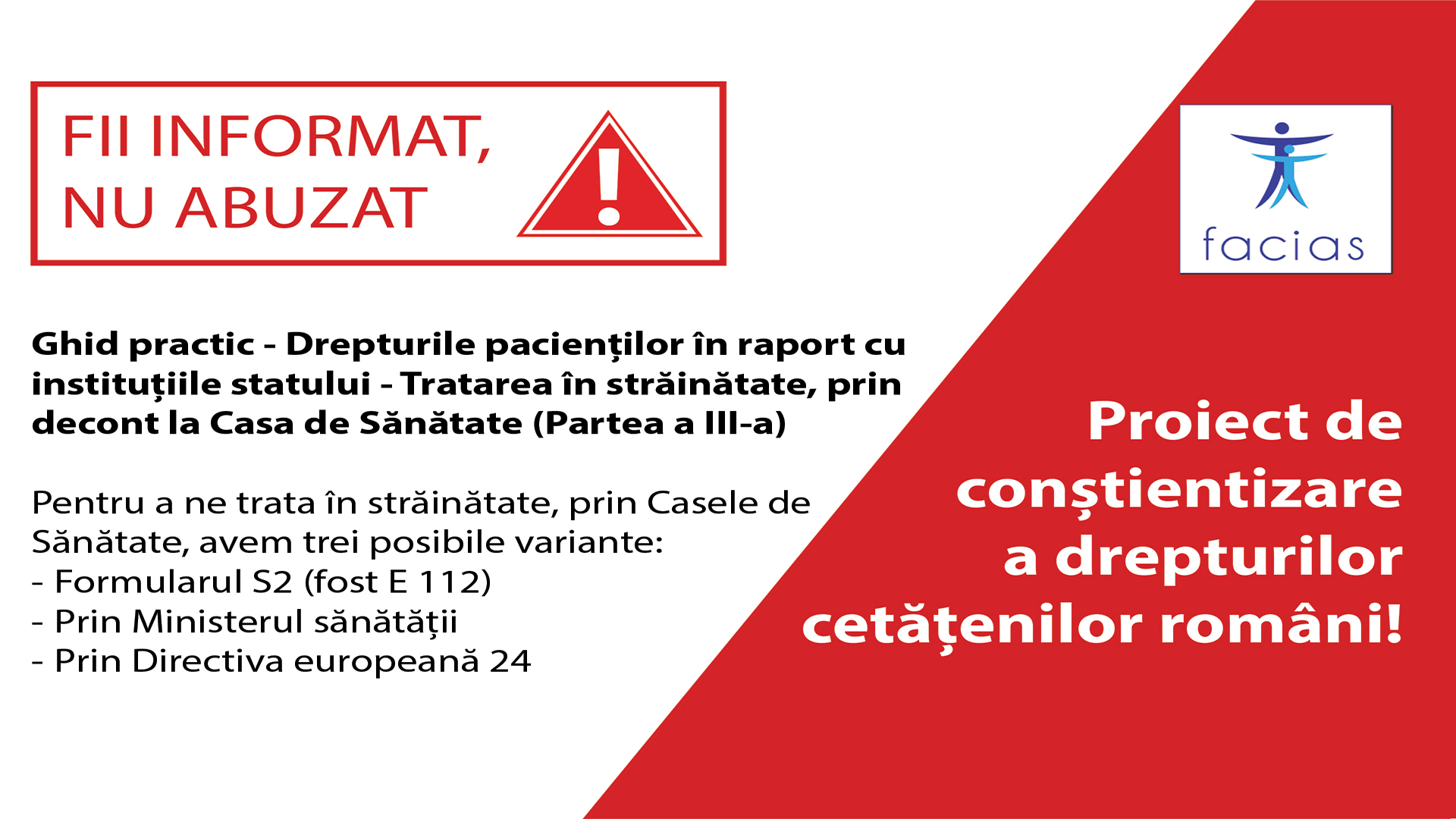
There are three possible options for treatment abroad through the health insurance companies:
Form S2 (formerly E 112): the right to be treated abroad when our condition cannot be treated in Romania
Through the Ministry of Health: the right to be treated abroad when our condition cannot be treated in Romania
By EU Directive 24: Right to treat ourselves in the EU, for reasons other than the above (we trust those services more, we have family in that country, we live at the border and the hospital in the neighbouring country is closer)
Note: Although all three modalities are settled through the Health Insurance Fund, we have a difference between them in terms of payment made.
In the first two options, the treatment and medical services are paid directly to the hospital abroad by the health insurance company.
In the third case, we must pay on spot, and then the national authority in the country of origin reimburses us as quickly as possible. CAS cannot deny us this right.
We take them one by one, but remember that you have the sources of information in this text available to you, precisely because this Practical Guide is intended to provide quality support, but it cannot cover absolutely everything, only the essential information. If you find yourself in such a situation, it is good to know what rights you have, how to claim them, what to do and where to get your information. This Practical Guide is also a support to help you know where to get your information, in more detail.
In this episode we will also talk about our health rights, namely the right to treat ourselves abroad. However, it is necessary to know that, in addition to this, we also have situations where we can treat ourselves abroad (when we are in transit or for a period in a country, or when we work abroad, seconded), but we will only deal with these tangentially.
II. EU DIRECTIVE NO 24
It is a practical instrument that guarantees us the right to be treated abroad, with costs covered, through a settlement, by the Health Insurance Company, even if our problem is not a serious, life-threatening one, as in the other two situations.
So, the third way in which services provided in other hospitals abroad can be settled is Directive 24, which came fully into effect in 2013. The directive allows Romanian patients to be treated in any hospital in the EU, private or state, obliging the Romanian state to settle these services at the level of the tariffs for the services in question in Romania.
- The Directive can be found here:
https://eur-lex.europa.eu/legal-content/RO/LSU/?uri=CELEX:32011L0024 .
- Its transposition into Romanian law can be found here:
http://legislatie.just.ro/Public/DetaliiDocument/213679 .
This useful tool is for patients who have the right to seek treatment in the EU in situations other than those where the treatment we need is not available in our home country.
The disadvantage of this system (provided by EU Directive 24) is that patients have to pay on the spot, and then be reimbursed by the national authority in their home country as quickly as possible.
Although we can be treated in Romania, in some cases we opt for care in another EU country.
We can use this instrument in the following situations: highly specialised medical care and/or care provided in border areas, if the nearest appropriate hospital is on the other side of the border", according to the Directive.
The Directive is also useful for situations where "patients wish to receive treatment abroad in order to be closer to family members or to have access to a different method of treatment than that offered in the Member State or because they believe they will benefit from better care in another state".
The Directive applies to the provision of services to patients irrespective of the way in which the hospital unit in which we are treated (it may be private or state-owned) is organised, delivered and financed.
We have this right, given to us by EU Directive 24, and we cannot be refused by hospitals in EU states, even on the pretext that "there are waiting lists on national territory without objective medical assessment".
Note: Long-term care services (medical rehabilitation), organ transplants and vaccination programmes against infectious diseases are not covered by the Directive.
The National Health Service (through the National Contact Point for Cross-Border Care) also provides information on how to use this tool, Directive 24, to our advantage here: https://ec.europa.eu/commission/presscorner/detail/ro/MEMO_13_918 .
The European Commission provides us with more questions and answers to help us use this right, guaranteed by EU Directive 24, here:
https://ec.europa.eu/commission/presscorner/detail/ro/MEMO_13_918
We hope you will never need these tools, but if you do, you will know what your rights are, who and what your responsibilities are and what you have to do.
III. NEXT WEEK: WHAT DO WE DO WHEN THE HEALTH PROFESSIONALS THEMSELVES VIOLATE OUR RIGHTS?
Next week we will address another issue, this time related to the pandemic context: patients' access to healthcare in cases of serious illness, even if they are not emergencies. Through the questionnaire you have filled in and through comments or messages, you have brought to our attention painful situations where you have lost relatives because they were not treated in time, under the argument that it was not an emergency, even though their illnesses were serious.
Another serious problem you raised was that some medical procedures were carried out without the consent of the patient or relatives.
A third problem often reported was that there was no proper communication between doctors, patients and their relatives and that you were often told that everything was fine, as if it were automatic, and then you found out, again late, that the patient was already dead.
The situations are painful. We know that we cannot turn back the clock to avoid these complicated situations.
What can we do?
We will try to provide you with some information and tools, in a simplified way, to know exactly what rights we have (we often do) in such situations, who we ask, how we enforce them, where we complain, what laws we invoke.
Like you, we have met professional health professionals, many of them, but there are exceptions in the medical system too, and from your messages, it seems that we are increasingly encountering exceptions that make our lives an ordeal just when we need the help we are most entitled to, and sometimes this right is being violated.
In our experience, although there should normally be no difference, we have often observed that certain medical professionals (those who, even if they are not in the majority, unfortunately, make our lives difficult just when we need the most support) become, to a certain extent, what they should be, when they see that the man in front of them knows his rights, points them out to him, and draws attention to the fact that he is violating them.
IV. SOURCES OF INFORMATION
- Pag 36-37 din Ghidul Asiguratului (vizează și persoanele neasigurate), disponibil aici: https://cnas.ro/ghidul-asiguratului/
- Rubrică Sănătate (din MENIU)-Tratamente Planificate în Străinătate, de aici: https://europa.eu/youreurope/citizens/health/planned-healthcare/expenses-reimbursements/index_ro.htm
- Formularele necesare, inclusiv S2, se regăsesc aici și pot fi downloadate: https://europa.eu/youreurope/citizens/work/social-security-forms/index_ro.htm
- Punctul Național de Contact (Asistență medical transfrontalieră: http://www.cnas-pnc.ro/
- Medicii de familie și medicii specialiști
- Casele de sănătate
- Asiguratorii (fie că sunt asigurări private sau nu)
- Informații din materialul (foarte bine structurat), de aici: Tratament în străinătate, cu fonduri de la statul român: http://www.asociatiapavel.ro/informatii-utile-despre-tratamente-in-st
- Cum poţi beneficia de tratament în străinătate, plătit de statul român. Cele trei soluții posibile de aici: https://totuldespremame.ro/utile/legislatie/cum-poti-beneficia-de-tratament-in-strainatate-platit-de-statul-roman-trei-solutii-posibile
- Procedure for issuing the S2 portable document: http://cas.cnas.ro/casbh//media/files/Procedura_de_emitere_a_documentului_portabil_S2.pdf
- Tratamente în străinătate. Documentul portabil S2 : https://www.drepturilepacientilor.info/ro/utile/tratamente-in-strainatate-formularul-e112
- Pentru finanțare tratament în străinătate, prin Ministerul Sănătățiii: ORDIN nr. 50 din 23 ianuarie 2004 privind metodologia de trimitere a unor categorii de bolnavi pentru tratament în străinătate: http://legislatie.just.ro/Public/DetaliiDocument/49432?isFormaDeBaza=True&rep=True
- Directiva 24: Asistența medicală în alte țări ale UE – drepturile pacienților: https://eur-lex.europa.eu/legal-content/RO/LSU/?uri=CELEX:32011L0024
- Transpunerea Directivei Europene nr 24, în legislația românească, prin ORDONANȚA DE URGENȚĂ nr. 2 din 29 ianuarie 2014 pentru modificarea și completarea Legii nr. 95/2006 privind reforma în domeniul sănătății, precum și pentru modificarea și completarea unor acte normative: http://legislatie.just.ro/Public/DetaliiDocument/213679
- Comisia Europeana: Întrebări și răspunsuri legate de drepturile asigurate prin Directiva 24: https://ec.europa.eu/commission/presscorner/detail/ro/MEMO_13_918
- Casa Națională de Sănătate (prin Punctul Național de Contact pentru asistență transfrontalieră) ne oferă și ea informații despre cum să folosim acest instrument, Directiva 24, în interesul nostru, aici: https://ec.europa.eu/commission/presscorner/detail/ro/MEMO_13_918
- Presentation of social security systems - including health - in other EU Member States and Switzerland: https://mmuncii.ro/j33/index.php/ro/2014-domenii/protectie-sociala/securitate-sociala-pentru-lucratorii-migranti/916-prezentarea-sistemelor-de-securitate-sociala-din-alte-state-membre-ale-uniunii-europene-si-elvetia