

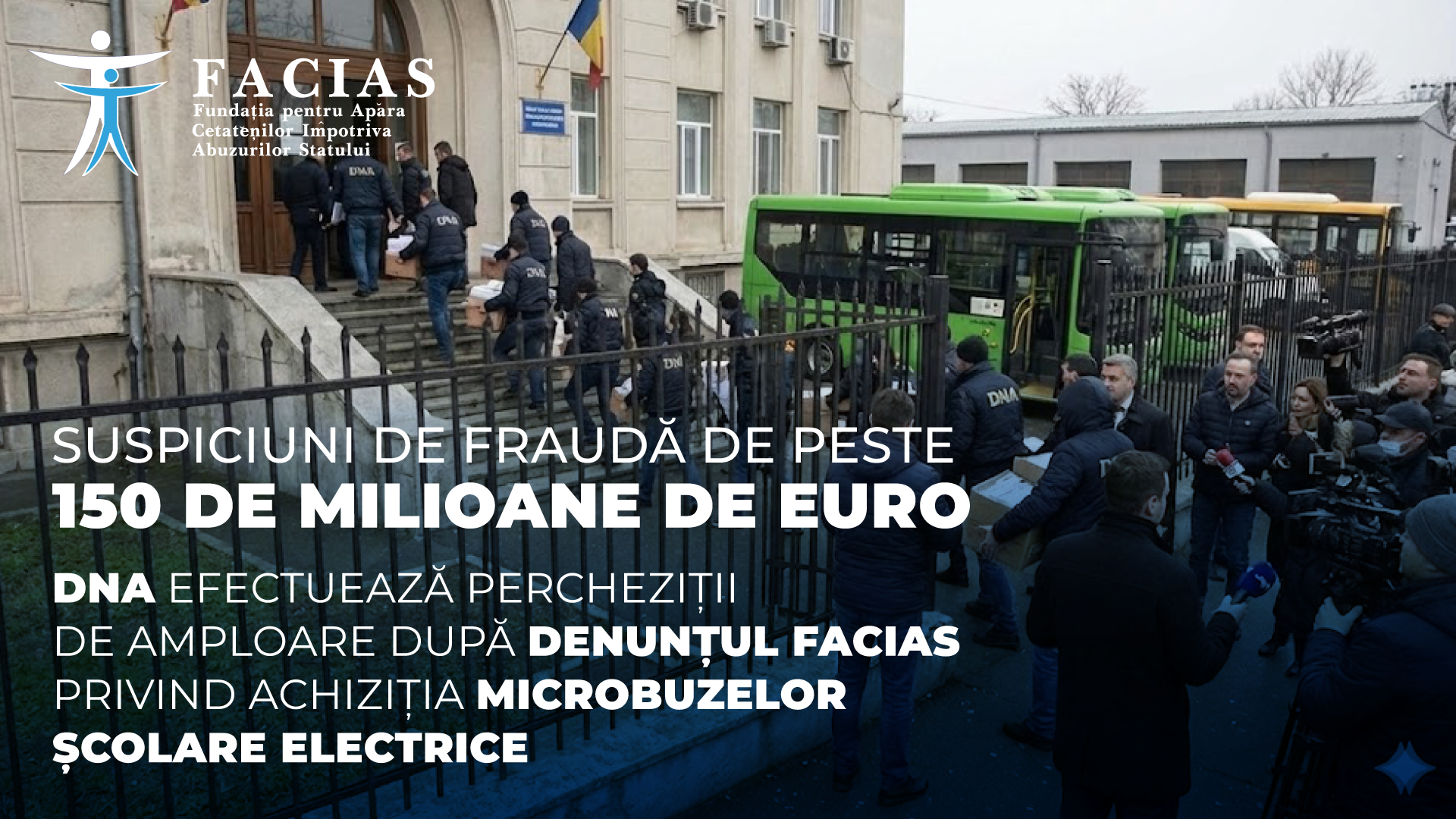
Following a denunciation filed by The Foundation For The Defense Of The Citizens Against State Abuses (FACIAS), prosecutors from the National Anticorruption Directorate (DNA) carried out nationwide searches earlier this week to check possible fraud in the purchase of electric school buses financed by the National Recovery and Resilience Plan (NRRP). According to the latest response received by FACIAS from DNA, the case is being investigated by prosecutors from the Section for Combating Crimes Assimilated to Corruption.
In September 2025, FACIAS asked prosecutors to investigate how contracts for the purchase of electric minibuses were awarded by the Ministry of Education and county councils, which set out both the technical characteristics of the vehicles and the estimated values for each lot. FACIAS pointed out that these contracts may have been overpriced, constructed with restrictive technical criteria and set up in such a way as to limit competition, which resulted in 35 of the 40 contracts being awarded to one company.
In September 2025, FACIAS asked prosecutors to investigate how contracts for the purchase of electric minibuses were awarded by the Ministry of Education and county councils, which set out both the technical characteristics of the vehicles and the estimated values for each lot. FACIAS pointed out that these contracts may have been overpriced, constructed with restrictive technical criteria and set up in such a way as to limit competition, which resulted in 35 of the 40 contracts being awarded to one company.
Through the NRRP, Romania was allocated funds for the purchase of 3,200 electric minibuses, but in reality only 1,300 were bought, although the total budget of around €250 million was almost entirely consumed. Prosecutors are now investigating how it was possible for the state to obtain less than half of the planned number of vehicles, when the funding would have covered all the needs.
In the analysis that led to the denunciation, FACIAS identified a series of almost identical procurement procedures in numerous counties: few or no competitive offers, restrictively constructed tender specifications and the successive award of 35 contracts to S.C. Aveuro International SRL. This unprecedented concentration, combined with the lack of real competition, was an indication that the procurement mechanism may have been artificially constructed to favor a single economic operator.
FACIAS also uncovered major vulnerabilities in the structure of the school electric minibus program. Although the investment was supposed to be standardized at national level, each county council drew up its own specifications and market studies, without a centralized verification to prevent abuses. This decentralization led to huge differences between the real costs of vehicles and the prices accepted by the authorities.
Concretely, while NRRP and European Commission estimates suggested a cost of around €80,000 for an electric minibus, many counties have accepted prices of over €200,000, in some cases reaching up to €262,000 per vehicle. In the county of Iași, a minibus was purchased for €202,800, in Olt values exceeded €230,000 and in Mureș they approached €200,000.
At the other extreme, Brașov County Council paid around €147,000 per minibus, while Bistrița-Năsăud County reported an estimated value of around €107,000 for a similar purchase.
According to calculations resulting from the difference between the real costs of the vehicles and the prices paid through public contracts, the potential damage to the EU funds allocated to Romania could exceed €150 million
As a result of these irregularities, a number of minibus purchases have already been blocked or delayed, directly affecting the communities that depend on this transportation. FACIAS considers it essential that the DNA investigation quickly clarifies who is responsible so that the school mobility programs funded by the NRRP can continue legally and transparently, without harming pupils and without jeopardizing the European funds allocated to Romania.