FACIAS ran the "Be informed, not abused!" project between April amd February 2022.
These issues were revealed, particularly by the approximately 1000 responses to the FACIAS Questionnaire and the over 3000 messages received."
One of the five key difficulties mentioned for which we were asked for citize support in the Health domain is:
- Simple access to a list of charges that directly affect them, in real time, to see how much they spent on their health and how much they paid in the state health insurance account. Many Romanians have complained that, despite paying for health insurance, they are frequently told that there are no funds when they require care.
I.UPDATED OFFICIAL INFORMATION:
Source: National House of Health
Verification of the quality of insurance can be done at: https://cnas.ro/verificare-asigurati/
- Source: National House of Health
The national health card provides access to medical services throughout Romania.
- The health card is used to obtain medical services wherever the patient goes.
- With a health card, the patient is no longer required to show proof of work or insurance.
- The health card also serves as a deterrent to the practice of fraud in the health insurance system.
It is a critical element in the management of health-care funds.
All insurance systems around the world are vulnerable to fraud.
The card serves as a link between what clinicians proclaim and what patients receive.
- The card would have two components:
- a service access component based on the insured's quality,
- and a component containing information about the patient's condition, i.e. his electronic medical file (DES-already implemented from Dec 2021).
These frauds can only be limited by closely monitoring the money circuit and the payment of services. We can deduce (FACIAS) from this (information on the CNAS website) that these expenses are known. It is appropriate for the patient to see them at any moment, just as an account statement, to find out what they paid and how much they spent.
I.1.DATA COLLECTED AFTER DISCUSSIONS WITH HOSPITAL MEDICAL PERSONNEL AND PATIENTS
- Source: medical-surgery personnel
Today, the following practice is common in hospitals:
The patient is checked into Hospital A.
SETTLEMENT- expenses/patient
In parallel with the Billing Sheet for that patient, the Discharge Sheetis redacted (to be given to the patient), which includes all costs for each applied operation, including the hotel regime. All of Settlements's costs are still in hospital A's database, waiting to be settled at CNAS.
If the patient is transferred to another hospital, B will accompany him with the discharge papers and that will be the end of it. Hospital B will not be able to access the database pertaining to it from Hospital A.
NOTE: For hospitalizations caused by aggressiveness or automobile accidents, the patient bears the costs, which are recovered from the insurer or, after a process, from the guilty party (if he is not guilty, but it is the court's business).
- Source - Patients:
We highlight that, as part of the FACIAS investigation, we recently identified a patient who received this SETTLEMENT upon discharge. It remains to be seen whether the transmission of this account is at the discretion of the hospital because there is no legal duty in this regard in the legislation.
I2. THE LEGISLATION GOVERNING THE OBJECTIVE'S SCOPE
- Health Reform Law No. 95 of April 14, 2006: https://legislatie.just.ro/Public/DetaliiDocument/71139
- HOTĂRÂRE nr. 900 din 1 septembrie 2012 pentru aprobarea Normelor metodologice de aplicare a prevederilor referitoare la cardul naţional de asigurări sociale de sănătate din titlul IX “Cardul european şi cardul naţional de asigurări sociale de sănătate” din Legea nr. 95/2006 privind reforma în domeniul sănătăţii: https://legislatie.just.ro/Public/DetaliiDocumentAfis/141110
- Hotarârea nr. 483/2020 pentru completarea Normelor metodologice de aplicare a prevederilor referitoare la cardul național de asigurări sociale de sanatate din titlul IX: “Cardul european și cardul național de asigurări sociale de sanatate” din Legea nr. 95/2006 privind reforma în domeniul sanatatii, aprobate prin Hotărârea Guvernului nr. 900/2012 : https://legislatie.just.ro/Public/DetaliiDocumentAfis/227130
- Normele metodologice de aplicare a prevederilor referitoare la cardul naţional de asigurări sociale de sănătate din titlul IX “Cardul european şi cardul naţional de asigurări sociale de sănătate” din Legea nr. 95/2006 privind reforma în domeniul sănătăţii din 01.09.2012 :
- ORDER NO. 98 of February 27, 2015, for the approval of the issuance procedure, the method of bearing the expenses related to the production and distribution of the duplicate card to the insured, and the method of granting medical services, medicines, and medical devices until the issuance or in the case of refusal of the national card social health insurance: https://legislatie.just.ro/Public/DetaliiDocumentAfis/166746
II.AFACIAS-PLANNED ACTIONS, PER OBJECTIVE (JULY-SEPTEMBER PERIOD)
Action 1: Information Request (implemented - responses are awaited)
- Information requested CNAS level:
- What legislation controls an individual's access to information about the costs of the health-care system?
- In Romania, how many people are insured?
- Is the DES (Electronic Health Record) linked to your health card?
- Why, despite having a Health Card, is the patient asked for proof of insurance upon discharge for Medical Leave?
- As long as all costs/patient are documented in the public and private health systems via the Health Card (if in contract with the CNAS), it implies that at the CNAS level, based on the CNP (or the Health Card), it is possible to know how much was consumed with each patient during his life as a patient. How will the patient pay for these expenses? What are the procedures? Is this still possible today?
- If the patient cannot easily access the list and the amounts spent on it, who should take the necessary steps to make it possible?
- Is there data on costs per patient at the CNAS level? How do we access them?
What is the most a patient has consumed in his entire life/year?
What is the lowest amount consumed/patient, in his entire life/year?
What is the average amount consumed per patient over the course of his life/year?
- Can these amounts be found for minors (to which their guardians can have easy access)?
- What steps should a patient take right now in order to be aware of the expenses incurred by the state for the benefit of his health?
- Have sanctions been imposed on medical service providers (with or without a contract with CNAS) for failing to comply with the legal requirements for the registration of medical data in the DES? (EHR) (electronic health record) In that case, how many sanctions have been imposed thus far?
- How many healthcare providers and/or doctors, out of all doctors and health care providers in the country, comply with their obligation to enter data in the DES?
- Are only service providers under contract with the Health Center eligible to participate in DES?
- Is it possible to enroll in both DES and private health care?
- 17. Today, the following practice is common in hospitals: The patient is checked into Hospital A. Parallel to the discharge form (which is handed to the patient), a bill for expenses/patient is created, which covers all charges for each surgery performed, including the hotel regime. All of the charges in the Settlement remain, but they are not recorded in the database of hospital A, to be settled at the CNAS, to the patient, or in a database to which they have access. How can the patient gain access to the expenses that concern him? If the patient is transferred to another hospital, B will accompany him with the discharge papers and that will be the end of it. Hospital B will not be able to access the database related to the patient from Hospital A.
- According to circulating information, the Health Center does not have full access to all of the Health Card application's functions because the company that created the software solution and provides maintenance has kept certain data for management, specifically to keep the CNAS dependent on its services. What can you tell us about this topic?
- Information requested from the Ministry of Health
- Is the DES (Electronic Health Record) linked to your health card?
- Why, after discharge, is the patient asked for proof that he is insured for the medical leave, despite the fact that he has a health card?
- As long as all costs/patient are registered in the public and private health system through the Health Card (if it is under contract with CNAS or other), it means that, at the CNAS level, based on the CNP (or the Health Card), it can be seen that how much was consumed with each patient. How will the patient access these expenses? What are the procedures? Is this still possible today?
- If the patient cannot easily access the list and the amounts spent with it, who should take the necessary steps to make it possible?
- Is there data on costs per patient at the CNAS level? How do we access them?
- What is the most a patient has consumed in his entire life/year?
- What is the lowest amount consumed/patient, in his entire life/year?
- What is the average amount consumed per patient over the course of his life/year?
- Can these amounts be found for minors (to which their guardians can have easy access)?
- What steps should a patient take right now in order to be aware of the expenses incurred by the state for the benefit of his health?
- Are only service providers under contract with the Health Center eligible to participate in DES?
- Is it possible to enroll in both DES and private health care?
- Information requested at the level of the Health Committees in Parliament (possibly also at the level of the Information Technology Committee)
- As long as all costs/patient are registered in the public and private health system through the Health Card (if it is under contract with CNAS or other), it means that, at the CNAS level, based on the CNP (or the Health Card), it can be seen that how much was consumed with each patient. How will the patient access these expenses? What are the procedures? Is this still possible today?
- Do you think it's possible to limit the patient's access, based on the CNP, to a read-only database where he can see all the costs (public and private) in relation to him?
- 3. Who / what institution would be in charge of putting such a beneficial measure in place, not only for patients, but also for the collection of data that would serve as the foundation for applicable, actionable public health policies?
Action II (August)A questionnaire will be distributed on the FACIAS Facebook page to determine how many Romanians want access to view the expenditures sustained by the health system, solely for them, at all times:
A link to where they can check their insurance status will be included in the Call to Action.
III.POTENTIAL BENEFITS RESULTING FROM OBJECTIVE IMPLEMENTATION
- The System and the Patient are both aware of the annual cost of health-care services at any given time.
- The patient knows exactly how much he paid to the health system and how much the medical system consumed for his health at any given time.
- The state can produce useful public policy based on real-time data (costs per patient/disease code, for example).
- The state can manage the funds more effectively for the benefit of the patient
- The state can identify preventive measures (much cheaper than treating the condition itself).
- Other benefits
IV.CONTEXT:
March 2019 Situation (EUROSTAT):
Romania has one of the lowest life expectancy rates in the EU, 6 years lower than the EU average.
Prevention funding is low, and access to prevention programs is inconsistent (1.8% of total health spending).
In 2017, Romania spent 1,029 EUR per person on health (adjusted for purchasing power variations), less than half of the EU average of EUR 2,884 or 5% of GDP (compared to the EU average of 9.8%).
More than three-quarters of health spending is paid by the government (79.5% in 2017), matching the EU average of 79.3%.
Direct payments are the second most major source of income, accounting for 20.5% of health expenditure in 2017. (section 5.2). Informal payments are thought to be significant, while their entire worth is unknown.
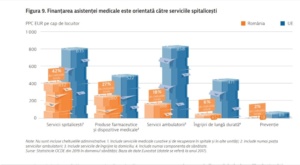
Health expenditures (latest data-2017) are at historic lows; they are lower per capita and as a proportion of GDP than in any other EU country (5.2% of GDP in 2017, compared to the EU average of 9.8%). The system's underfunding has an impact on Romania's ability to meet the population's existing needs, a scenario that will become increasingly challenging as the population ages and the resource base declines.
Direct payments, particularly for ambulatory care medications, are a challenge to access:

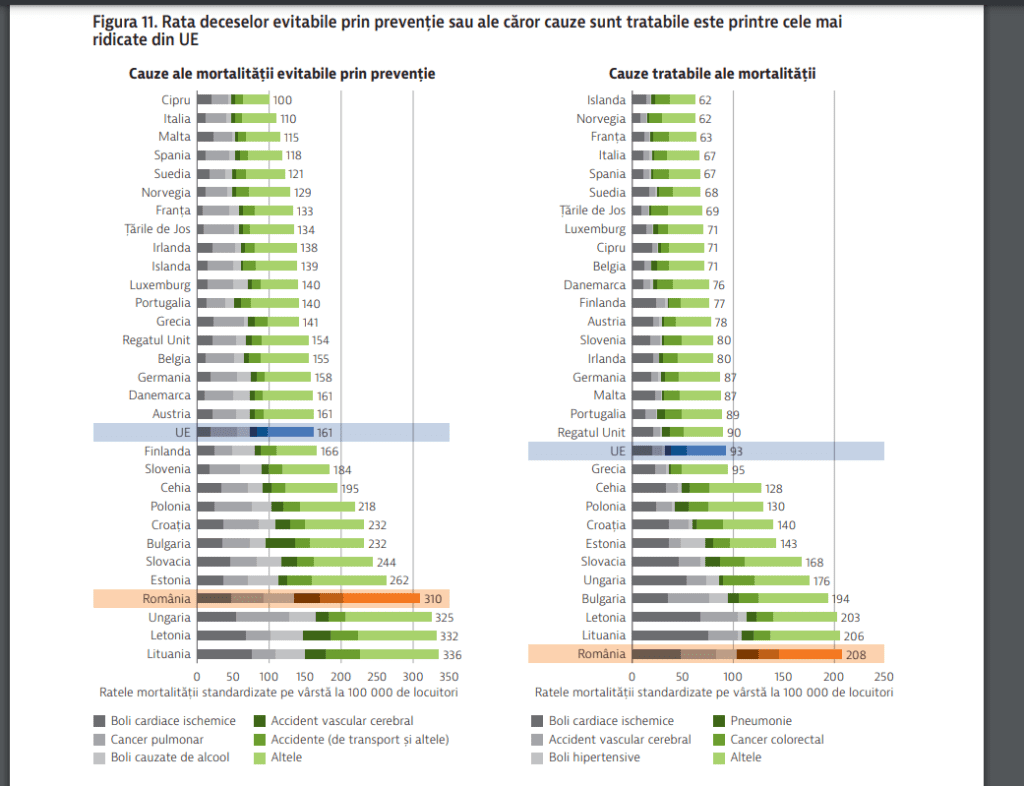
Situation in 2020file:///C:/Users/ella.nica/Downloads/Romania-CountryHealthProfile2021.pdf)
Romanian health spending has increased over the last decade, although it remains the second lowest in the EU as a proportion of GDP and per capita.
Prevention spending per capita is the second lowest in the EU.
Romania's health spending has increased dramatically, although it remains one of the EU countries with the lowest health spending, both per capita and as a proportion of GDP.