

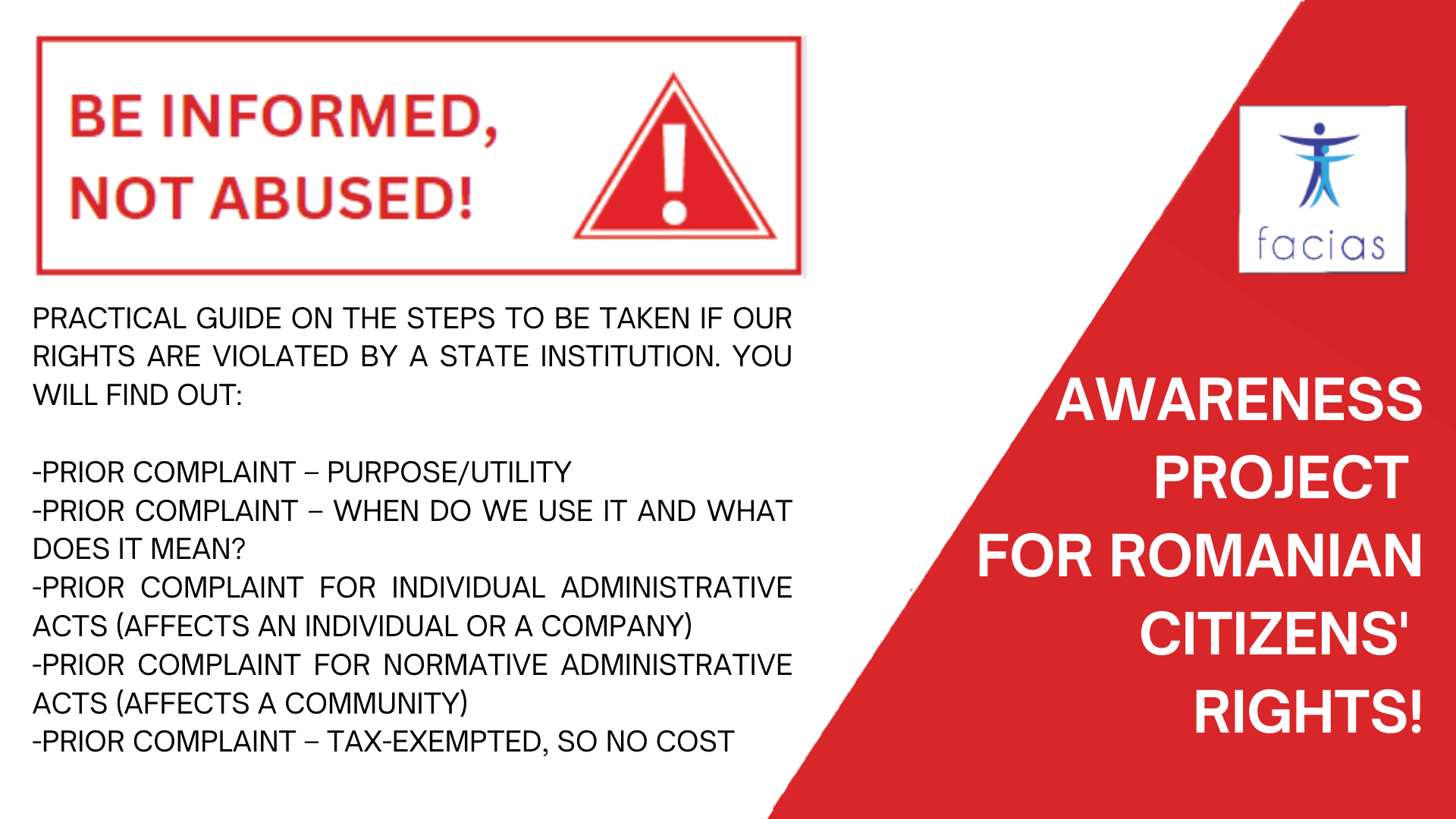
The following were included from previous materials of the FACIAS Guide, created as your support in relation to governmental institutions:
- How do we, as citizens, recognize that we are being abused?
- Minimum criteria for identifying an abusive situation;
- Access to justice, as ensured by the courts;
- How can we do ourselves justice without costs?
- Where do we find valuable information about our rights, as well as the obligations of public institutions?
- Application/petition - First Step
- What are the response times mandated on institutions by law for our request/petition?
- Prior Complaint, free tool: why, how, and how it helps us.
FACIAS continues to complete the PRACTICAL GUIDE for the fight against abuses committed by state institutions, with new useful information about the Prior Complaint, covering the following aspects:
- To whom and how do we send our prior complaint
- What deadlines do we and the institutions have to respect
- What the prior complaint must contain
- How does the prior complaint help us, if we later decide to go to court
TO WHOM AND HOW DO WE SEND THE PRIOR COMPLAINT?
We only file prior complaints in writing and send them to the institution via register, post, or e-mail, but we must have proof that the institution received our request (registration number, proof of confirmation of receipt by mail, etc.), If we choose e-mail, we must ensure to transmit the prior complaint during the institution's working hours and request receipt confirmation.
What deadlines do we and the institutions have to respect
We submit the prior complaint, for individual administrative acts (affecting a natural/legal person), to the issuing public authority or the hierarchically superior authority within 30 days of the act that wrongs us (the date of communication is the date on which the institution answered our request - a request may be an environmental or construction permit, etc.). Individual complaints for normative administrative acts (those have a communal impact) can be filed at any time.
The institution is required to resolve our prior complaint within 30 days of receiving it.
What the prior complaint must contain
We provide an example model to assist you in drafting your own prior complaint. The concept is based on the Guide on Citizens' Rights in Relationships with the Public Administration and the Judicial System, which was created as part of the project "Legal Counseling Services for Victims of Abuse or Irregularities in Administration and Justice."
Model – mandatory prior complaint, descarcă plângerea în format PDf, descarcă plângerea în format word[2] :
Skip to PDF contentHOW CAN A PRIOR COMPLAINT HELP US IN THE FUTURE, IF WE DECIDE TO GO TO COURT
According to the "Guide for the citizens' rights in relations with the public administration and the judicial system"[1], in each situation "the specific legislation applicable in the case must also be checked to identify to what extent the legislator:
- provided for a special mandatory prior procedure (e.g., that provided for in the Fiscal Procedure Code)
- or referred to administrative litigation law, thus including art. 7 of this law (e.g., art. 30 of Law no. 416/2001 on guaranteed minimum income)
- or simply stated expressly that the prior complaint procedure does not apply in that situation (e.g., in the case of contesting the contravention that can be challenged under OG no. 2/2001 on the legal restitution)
In any instance, whether the law requires a mandatory preliminary administrative procedure to be completed before filing an action in administrative litigation[2], nothing precludes us from petitioning the public authorities to seek that they exercise their powers if we believe we have been wronged.
Art. 8 paragraph 1 of the Administrative Litigation Law regulates the object of the judicial action as follows: "(1) The person injured in a right recognized by law or in a legitimate interest by a unilateral administrative act, dissatisfied with the response received to the prior complaint or who did not receive any response within the term provided for in art. 2 paragraph. (1) lit. h), can notify the competent administrative court, to request the annulment of the act in whole or in part, the reparation of the damage caused and, possibly, reparations for moral damages."
Art. 12 of the same law also specifies what we do if the public institution does not respond to our complaint: "The plaintiff attaches to the action the copy of the administrative act he is attacking or, as the case may be, the response of the public authority informing him of the refusal to resolve his request. In the situation where the applicant has not received any response to his request, he will submit to the file the copy of the request, certified by the number and date of registration with the public authority, as well as any document that proves the completion of the preliminary procedure, if this step was mandatory. In the situation where the plaintiff files an action against the authority that refuses to enforce the administrative act issued following the favorable resolution of the request or the prior complaint, he shall also submit the certified copy of this act to the file."[3]
Extra Info:In the following article we will briefly present steps that we have to take without going to court yet
[1] Available at http://acces-justitie.ro/uploads/articole/attachments/5e6a0cadb6a4b007807158.pdf
[2] Action in administrative litigation means that we go to court, we sue the institution
[3] Art. 12, Administrative Litigation Law, available free of charge,