

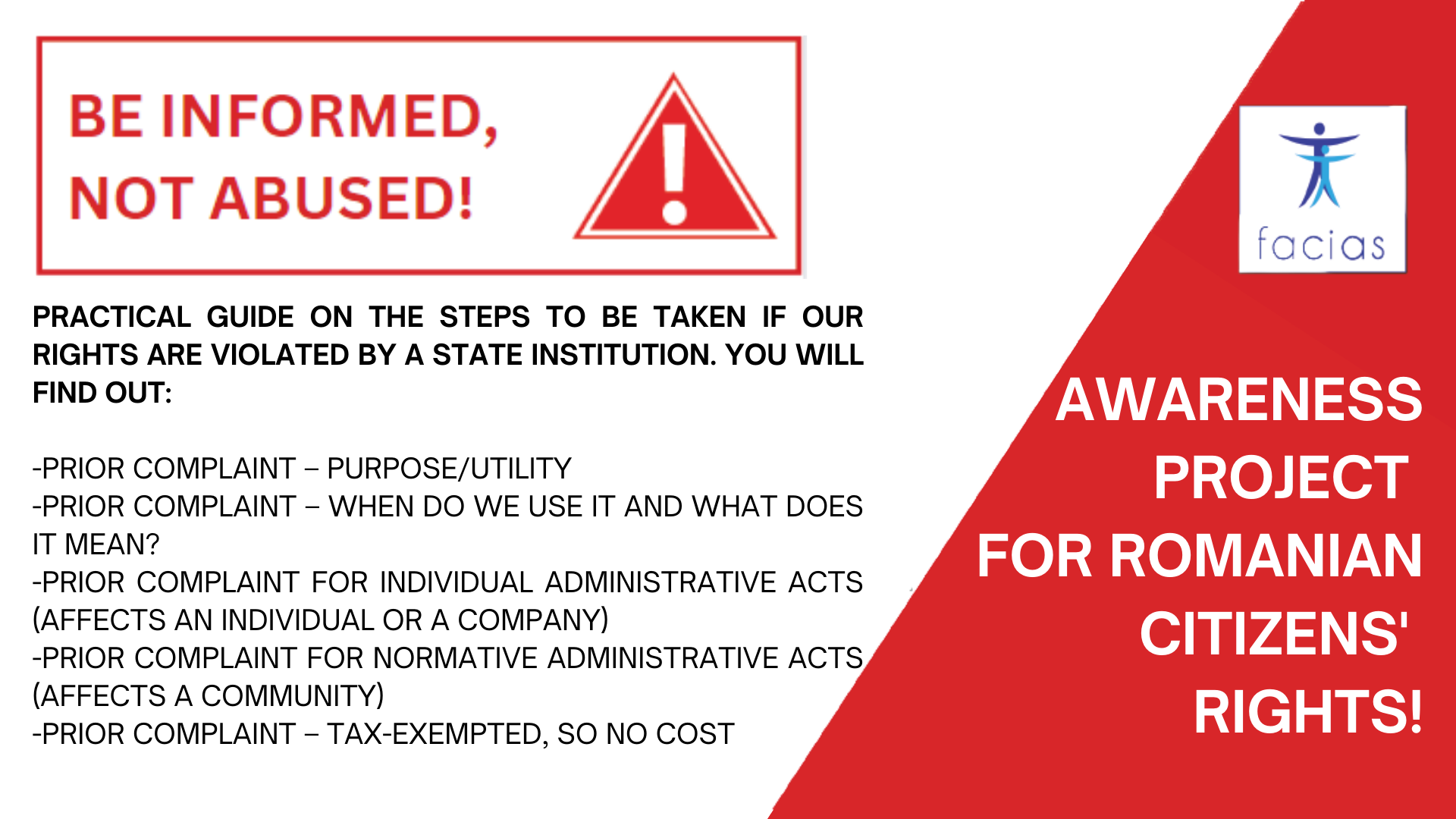
Contents:
- Prior complaint – purpose/utility
- Prior complaint – when do we use it and what does it mean?
- Prior complaint for individual administrative acts (affects an individual or a company)
- Prior complaint for normative administrative acts (affects a community)
- Prior complaint – tax-free, so no cost
- To whom do we forward our prior complaint?
In previous articles of the FACIAS Guide created to support citizens in relation to state institutions, we talked about:
- How do we, as citizens, realize that we are dealing with abuse?
- Minimum requirements for identifying a potentially abusive scenario
- Access to justice, ensured through state institutions or courts
- Information sources- knowing our rights and public institutions’ obligations
- The Request/Petition represents the first step & the response times imposed on the institutions, by law
- We can do justice without cost
This article will continue the growth of the FACIAS guide, applied in small steps but as simply as possible, by introducing another instrument that we can use with confidence when we believe that a state institution has violated a valid right: the prior complaint. Complaints in advance will also be extremely beneficial if we decide to go to court later. It is free and does not require a stamp. Even if we have already filed a petition or notification, we will be able to use the Prior Complaint tool.
1. PRIOR COMPLAINT – PURPOSE/ UTILITY
Before approaching the court, if we believe we have been affected in a legitimate right/interest by an administrative act, we demand that the issuing public authority or the hierarchical authority alter or annul the act, in whole or in part.
For example, any unjustifiable refusal to deliver the document sought by us, or a lack of response, gives us the right to file a prior complaint, and if the answer to it still violates our legal rights, we will proceed to court, later on.
We note that the administrative act that displeases us also refers to unilateral administrative acts and the unjustified refusal to resolve a request related to a right or a legitimate interest or, as the case may be, the fact that the institution did not respond to our request, within the legal term.
2.PRIOR COMPLAINT –WHEN DO WE USE IT AND WHAT DOES IT MEAN?
We realized or suspected that an injustice had been committed against us. Despite filing a petition and a complaint, we were nonetheless wronged. The Preliminary Complaint is the next tool (also part of the administrative procedures) that we can employ before proceeding to court. This tool is also highly valuable if we later decide that we can only resolve our problem in court.
The prior complaint is used to contest individual or collective administrative acts.
3.PRIOR COMPLAINT FOR INDIVIDUAL ADMINISTRATIVE ACTS (AFFECTING AN INDIVIDUAL OR A COMPANY)
We suppose that we individually requested (and followed the law's requirements) the issuing of a certificate, categorization in the degree and type of disability, or a building permit, or that we were refused the right to a leave, child support, and so on. Also, as a legal entity, we requested authorization, but our proposal was refused or amended, which we believe is unfair, and the situation tends to devolve into abuse committed by the state institution. Specific administrative acts, as they are referred to in various specialist texts, address individuals and/or legal entities.
4.PRIOR COMPLAINT FOR NORMATIVE ADMINISTRATIVE ACTS (AFFECTING A COLLECTIVITY)
When an institution's decision, such as a local council decision, targets a community, a group of directly impacted people, or anyone who can be influenced by it at a given time, we are dealing with normative administrative acts..
As a result, we can contest an administrative act that affects us and ask for its cancellation or modification. The unilateral act of individual or normative form issued by a public authority, under public power, in order to organize the implementation of the law or the concrete execution of the law, which gives rise to, alters, or eliminates legal relations is referred to as an administrative act[1].
Lastly, the prior complaint is an administrative method that we utilize before suing the institution, a tool that allows the offended individual to promptly resolve the misunderstanding with a public authority.
5.PRIOR COMPLAINT – TAX EXEMPT, NO COSTS
The prior complaint is a simple, quick, and tax-free method for us, persons affected in a right of ours by a public authority (public institution), to get immediate recognition of the claimed right or legitimate interest from the institution issuer.[2].
6.TO WHOM DO WE TRANSMIT OUR PRIOR COMPLAINT?
Administrative litigation law[3]art. 1, advises us to whom we should address this prior complaint.
We send our prior complaint to the institution in question (the one that issued the document that concerns us) or to its superior institution. We urge that the public authority that issued a possibly abusive/unfair act/decision/judgment, or the institution hierarchically superior to it, re-examine the individual act (affects a natural/legal person) or normative act (has an impact on a community).
If we believe we have still been wronged, we will go to court after we have made and received an answer to the prior complaint. We may also encounter instances in which the institution does not reply and we decide to go to court. We will require a copy of the administrative act being contested, as well as a copy of our previous request, as well as proof that the institution received this request.
FACIAS will continue to update this PRACTICAL GUIDE with new and relevant information on the prior complaint with the following aspects:
- To whom and how do we submit our Prior Complaint
- What are the deadlines for submitting a Prior Complaint and in how many days should we receive an answer
- What does the Prior Complaint contain and what does it looks like
- How can the Prior Complaint help us if we decide to go to court later on
[1] art. 1 alin. 2 lit. c – Administrative litigation law no. 554/2004
[2]The institution that issued the administrative act we are contesting
[3] The Administrative Litigation Law can be found, free of charge, here: http://legislatie.just.ro/Public/DetaliiDocument/57426