

"Be informed, NOT abused!", FACIAS's national project to raise awareness of the rights of Romanian citizens.
Summary:
- Main activities of the project
- Cumulative results of the FACIAS Questionnaire, at January 2022
- Practical guide for citizens in relation to state institutions, to defend their rights in relation to them, a guide produced as a result of the abusive situations most often reported by the respondents of the questionnaire and the approx. 2300 comments and messages
Information provided online as part of the "Be informed, not abused!" project reached over 1 million people.
Nine months after the launch of the "Be informed, NOT abused!" project, the Foundation for the Defence of Citizens against State Abuse (FACIAS) publicly presents the results for the period April 2021-January 2022.
The project is a community education project and aims to inform citizens about: the rights they have in relation to state institutions; identifying and addressing abuses when they are committed; knowing the organizations and institutions that can support them in fighting such abuses. FACIAS provides, on request, within the limits of its possibilities, support and advice to victims (mainly collective cases) of abuses committed by state institutions and collaborates with state institutions by identifying and promoting good practices to prevent such situations.
The project aims, implicitly, at stimulating the civic involvement of Romanian citizens, increasing the degree of responsibility and involvement in issues of national interest concerning the violation of their rights by state institutions.
I. The main activities of the project, carried out in the nine months since its inception, are:
- Informing citizens about their rights in relation to state institutions and the legal instruments they can use to seek justice: https://www.facias.ro/proiecte-2/
- Analysing problems reported by citizens; identifying practical solutions to them
- FACIAS questionnaire comprising eight questions: https://www.facias.ro/chestionar https://www.facias.ro/chestionar
The Practical Guide is based on the problems reported anonymously through the questionnaire and the approx. 2300 comments and messages received, to provide the information the Project public needs! In addition, the conclusions of the nine-month report are sent to the ministries coordinating public institutions for which abuses have been identified by respondents.
- Activities designed for pupils to gain the skills required for individuals who are civically involved in protecting their rights and/or the rights of others close to them: Student Essay Contest "Be Informed, Not Abused!" with awards ranging from 3000 to 1000 lei, held between October and December 2021: https://www.facias.ro/proiecte-2/
II. FACIAS Questionnaire Cumulative Results at January 2022
The Project Questionnaire contains 8 questions of which, two are open-ended.
Chestionarul este activ de la demararea proiectului (aprilie 2021) și va rămâne așa până la finalizarea sa, analiza răspunsurilor fiind actualizată periodic, în concordanță cu chestionarele completate de public.
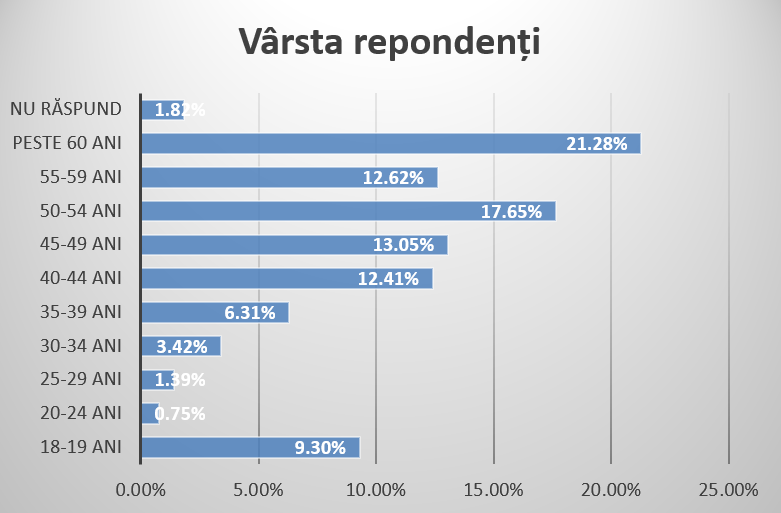
În ce privește categoriile de vârstă în care se încadrează respondenții, acestea sunt redate în tabelul de mai jos.
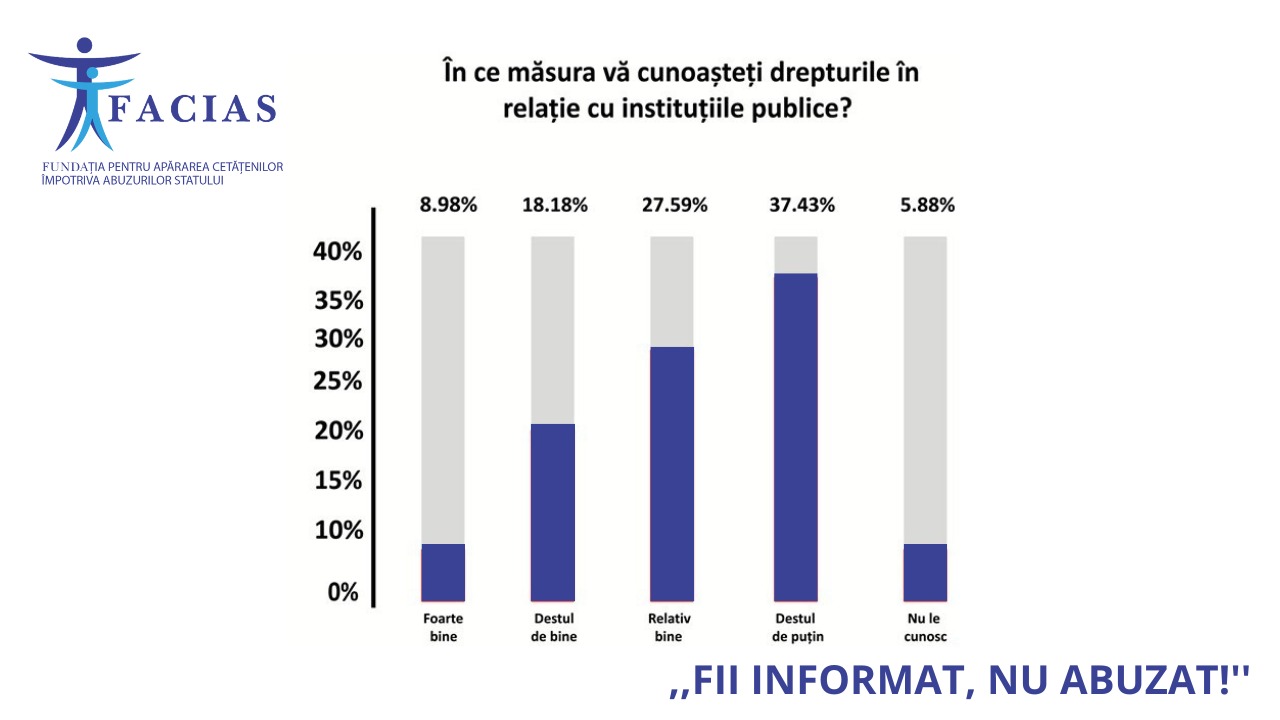
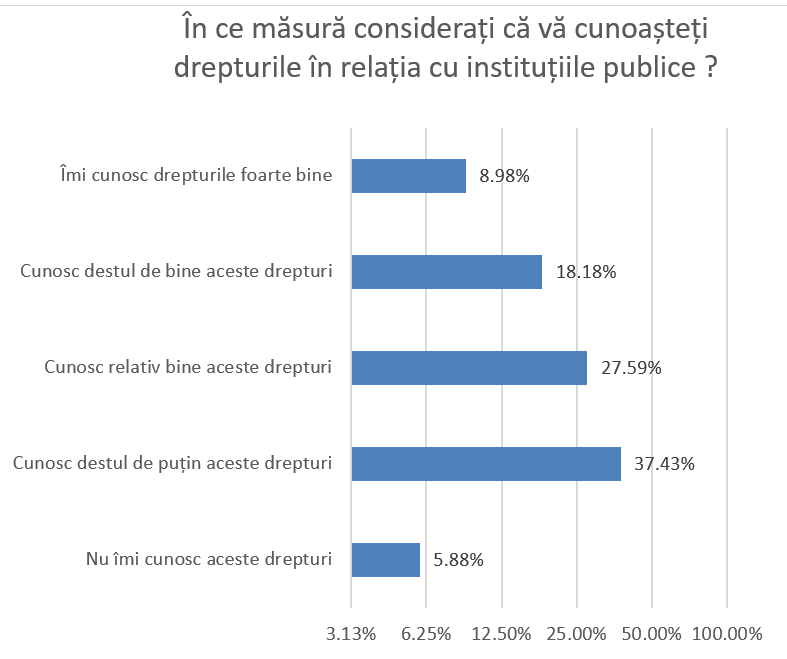
76.58% of respondents come from urban areas. 43.32% say they know very little or nothing about their rights; 45.78% think they know enough about their rights, while 8.98% say they know their rights very well in relation to state institutions.
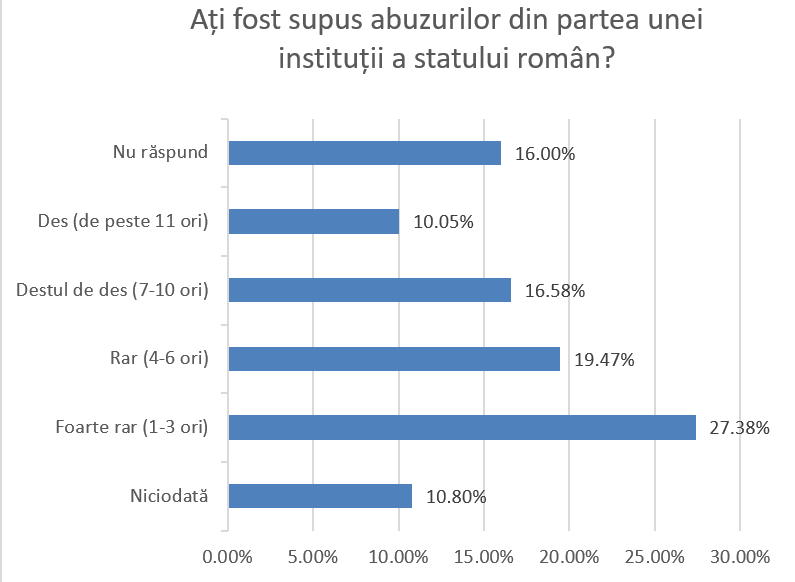
10.80% consider that they have not been a victim of abuse by a state institution; 46.84% have encountered a maximum of 6 situations of abuse in their lives; 26.63% claim to have been a victim of abuse more than 7 times. In total, 73.84% of respondents claim to have been at least once a victim of abuse by state institutions or their representatives.
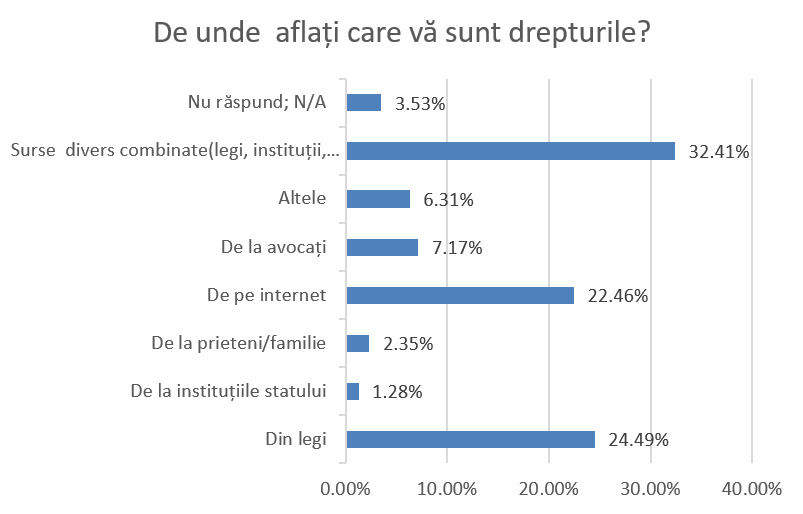
Regarding the source of information on their rights in relation to state institutions, 24.49% turn to legislation; 1.28% to state institutions; 22.46% get information from the internet; 2.35% from relatives and only 7.17% turn to lawyers. 32.41% turn to various combinations of the above sources of information.
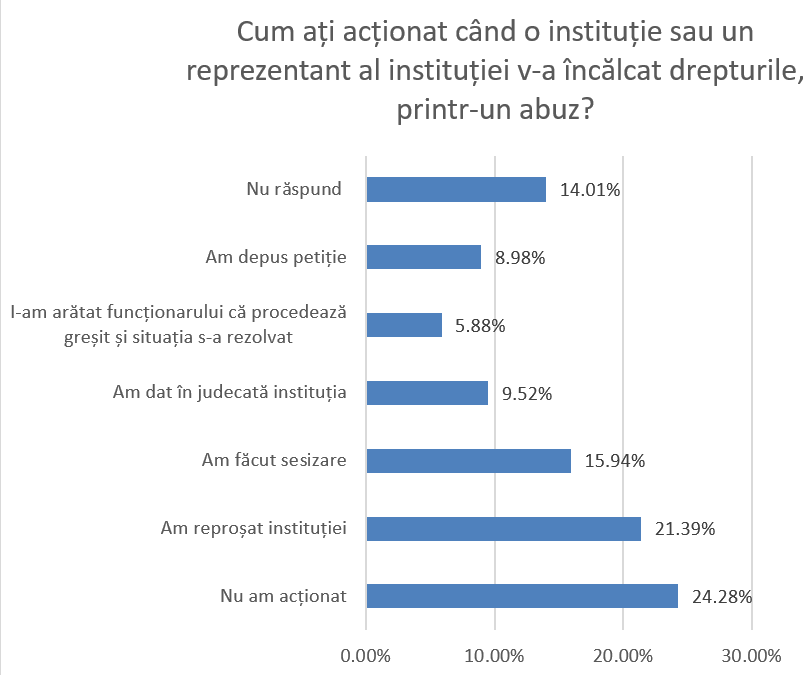
Of those who claim to have been victims of abuse by state institutions, 24.92% have filed petitions and complaints; 21.39% have drawn the attention of the institution by other means (verbal); 9.52% have appealed to the courts, and 24.28% of victims have not acted in any way. It is worth mentioning that 5.88% of those who considered that they were dealing with an abuse by the state ticked the option "I pointed out to the official that he was doing wrong and the situation was resolved".
Problems and potential abuses perceived and reported by respondents concern areas such as:
- Justice
- the tasks of the Territorial Administrative Units
- Health system
- the pandemic situation
- Care for people with disabilities
- Pensioners' rights
- ANAF, Police, Gendarmerie
- Employees' rights
- Energy and gas bills
Energy and gas bills
Citizens complained:
In Justice & Police & Gendarmerie
- Irregularities in inheritance lawsuits;
- Legislation constructed in such a way as to serve the interest of certain groups of citizens;
- Law enforcement/security institutions are assimilated as generators of abuses in their work;
- Abusive expropriation;
- The slowing down of police investigations; the request from some police officers to withdraw complaints in order not to have unfinished cases, instead of continuing investigations in a professional manner;
- Citizens feel they are not equal in rights and obligations;
- Modification of laws, often by GEO, to create advantages for some social categories at the expense of others;
- Inequality and unprofessionalism of courts and lack of fairness in investigations;
- Police, including prosecutors, do not take complaints seriously and do not investigate them professionally, discouraging people from seeking help;
- The judiciary complains that those who dispense justice in the courts are unprofessional or serve vested interests, with citizens feeling that they are not getting justice; the judiciary does not always respect the law;
- Offenders are often more protected than their victims;
- The delay of trials until the statute of limitations runs out and the feeling of being wronged during trials;
- Different court solutions for similar situations, even though the law is the same for all;
- The punishment of illegal parking when the municipalities are not obliged by law to provide parking spaces;
- The punishment of illegal parking when the municipalities are not obliged by law to provide parking spaces;
- Justice accused of incompetence, corruption, disinterest, cover-up;
- Cops break rules (traffic or during state of alert), but fine citizens for legal rules they also break;
- Unjustified filing of cases and even ignorance of the law, ignorance;
- Gendarmerie: abusive behaviour, ignorance of the legislation on the basis of which fines are given.
Retrocessions/inheritances/trials in the court, in the field/UAT tasks in the field - (also found in perceived abuses in the field of justice):
- Failure by municipalities to issue documents for the removal of land ownership;
- Abusive retrocessions in support of interest groups connected to decision-makers to the detriment of the justiciable;
- Repossessions based on interest group criteria;
- Abusive expropriations without compensation;
- Non possession of inheritance on the grounds that the documents do not exist in the authorities' archives;
- Issuing false documents in support of clientelist groups;
- Refusal and/or delay in issuing documents.
In the field of health services:
- During the pandemic period, patients with other conditions felt neglected and delayed, a possible cause of worsening health conditions;
- Superficiality/unprofessionalism of medical care;
- Superficiality/unprofessionalism of medical care;
- Ignorance of patients' rights and lack of information and explanations in common language (especially related to ICU);
- Lack of funds prevents patients from having investigations - they are expensive and often they are not done;
- Abuse: withholding the health contribution in advance and, if necessary, the taxpayer pays again for health services;
- Abusive behaviour;
- Violation of patients' rights;
- Decisions on medical acts without consent of relatives and patients;
- Failure to inform relatives about the condition of patients in the ICU;
- Failure to inform relatives about the condition of patients in the ICU;
- Limited and delayed access to medical services in hospitals, leading to worsening of illness, including deaths;
- Drugs for serious diseases not approved for compensation.
Rights limitations due to the pandemic situation:
- During the pandemic crisis, municipalities refuse to pay taxes in instalments and freeze citizens' accounts even though they are affected by the pandemic;
- Abusive termination of employment contracts;
- Discrimination between vaccinated and unvaccinated in the context of the pandemic situation;
- Prohibition of access to public institutions without a "green" certificate, even though many activities require physical presence, especially for those who are not familiar with the tools available on the internet.
Caring for people with disabilities:
- Social workers for people with disabilities are refused employment by municipalities, despite the relevant legislation;
- Personal social workers for people with disabilities believe that they are entitled to extra pay for difficult conditions and that they are not paid according to a scale;
- Incorrectness of the wage law 153/2017 and law 448 for people with disabilities.
Retirement rights:
- Differential treatment between the majority of pensioners who are constantly having the law changed and pensioners with special pensions who are having their rights strengthened on the grounds that the right once earned cannot be changed;
- On pensions - failure to comply with Decree No 38/1990 on the granting of certain rights to rail transport staffhttp://legislatie.just.ro/Public/DetaliiDocumentAfis/897);
- Failure to comply with the legislation on early retirement (Article 65(5) provides for early retirement without penalty for persons who have lived in mining areas for 30 years - Partial early retirement | Law 263/2010 );
- Unjustified reduction of regular pensions in contradiction with special pensions;
- Failure to index pensions to the inflation rate;
- Lack of equity between pensioners of other categories and magistrates pensioners (VSR 190 vs VSR 605), imposed by HG.
Relations between citizens and state institutions:
- Lack of accountability of state institutions;
- Citizens who report irregularities feel persecuted and treated as criminals by institutions empowered to deliver justice;
- Lack of response from public institutions to citizens' requests;
- Violations of the following rights: the right to information, the right to a fair statement of reasons for an administrative act, the right to impartiality, fairness and proportionality when considering a request submitted by citizens to a public institution;
- Citizens are asked by state institutions to bring documents issued by other state institutions when they could retrieve them themselves (requires interconnected databases);
- Blocking of access to public information by the TAU or central institutions;
- Failure to provide answers to requests sent to public institutions (ANAF);
- Citizens are being shuttled from door to door;
- Contemptuous and/or abusive treatment of taxpayers;
- Local authorities also charge unoccupied premises for sanitation;
- Granting of building permits without respecting the rules;
- Citizens without access to technology are advised to download the institutions' forms from their websites;
- Local police fining old people who sell their own products on the street;
- Misbehaviour, abuse, unilateral decisions;
- Refusal to pay for transport for those who find work at long distances from their place of residence.
Tax & ANAF Taxpayer Relations :
- Automatic enforcement imposed by the authorities on citizens who are late in paying their tax, without giving them the option of paying in instalments or late by including a penalty;
- Lack of information on taxpayers' debts to the State, ignorance of which also generates penalties because they are not paid on time;
- Abuses committed by ANAF - abusing small businesses;
- Excessive taxation of labour and all income (48% tax on labour / 10% income tax, 19% VAT on everything you buy);
- Abuse: employee penalised by ANAF for employer's non-payment 10-12 years ago;
- Although arrears and penalties are paid, taxpayers complain that their accounts are still blocked;
- Unprofessionalism and delay in actions that are for the benefit of the citizen (refunding money taken in excess), but maximum speed in those that support ANAF's interest, even if incorrect);
- Continuing to impose taxes on companies already closed;
- Imposing payments based on wrong administrative acts.
Employee rights in public institutions:
- Discrimination in the workplace;
- Employees complain that hierarchical superiors verbally ask them to do/write various documents, although they do not have it in their job description, and those are turned against the intimidated ones because they are the ones who sign;
- Abuse of position by superiors in public institutions;
- Employment in state institutions on non-transparent criteria, including unfair competitions.
Other categories of problems and/or abuses reported in the questionnaires
- Violation of the rights to a decent living, to health and to fair justice;
- Companies deliver substandard services (gas, water, electricity) and if they stop the service they do not compensate the customer for the inconvenience, but if citizens do not pay on time they are automatically stopped and penalised;
- Non-compliance with GDPR;
- Difficulties in paying loans due to the pandemic situation;
- Combating misinformation requires time on the part of the public to become properly informed and identify false information;
- High school students - feel deprived of their freedom (even when they are of age, they are not allowed to leave high school);
- College of physiotherapists - abusive behaviour (lifts members' right to practice, Ministry of Health does not fulfil its duties - Min. Health but no response , although it is obliged under Law 226/2016 to take action);
- Public information is requested regarding state loans in the market and destination, i.e. reporting how loans are executed.
Significant differences between situations perceived as state abuse and potentially abusive situations:
Although 73.84% of respondents claim and perceive that they have been victims of abuses committed by state institutions, a first analysis of the messages received by FACIAS from citizens shows that about 28-30% report difficulties they face, not necessarily abuses by the state and about. 15-20% report a situation of potential abuse by a state institution.
Most of the situations that respondents report as abusive do not concern collective abuses, but rather individual abuses that concern them directly.
Since the launch of the Project, FACIAS has received around 2300 messages and comments from citizens reporting various problems they face.
III. The citizen's practical guide to state institutions
FACIAS provides, in episodes, a Practical Guide as a support for citizens in relation to state institutions, a text supported by current legislation. The detailed instructions can be accessed at https://www.facias.ro/proiecte-2/. The Guide has provided information in simple language on the free tools we can use in dealing with state institutions without having to go to court. Individual cases in which an individual or a legal person is affected are as follows:
- How do we know we are dealing with abuse;
- Minimum criteria to identify a potential abusive situation.
- Access to justice is provided to us by laws, through state institutions or courts.
- How we can get justice and at no cost: PETITION, COMPLAINT and PRE-APPEAL.
- How to request information of public interest, useful for our interest to prevent/fight an abuse committed by a state institution, under Law 544/2001.
- Defend, at minimal or no cost, and in court.
- Public legal aid, if we are unable to pay certain stamp or expert fees.
- The "robot" portrait of the person who is tempted/committing abuses, in his capacity as representative of the State, in relation to citizens.
- Advocacy - a basic tool in the fight against abuses of state institutions, with collective victims.
- Advocacy, in simple words, and Big Steps .
- The usefulness of an NGO partner who knows advocacy in our fight against collective abuse.
- What kind of NGO can help us in the fight against state abuse with collective victims?
- Why are NGOs a beneficial alternative in dealing with collective cases of abuse committed by state institutions?
- Steps to follow to challenge an abusively imposed fine.
- The steps we, as citizens, have to take if we want to have an input into the text of a bill when we consider it inappropriate/abusive.
- How do we properly inform ourselves and follow a bill in the Romanian Parliament?
- How do we challenge measures taken in the context of the pandemic if we consider them unfair?
- What, how, when can we do to defend students' rights in school?
- How do we inform ourselves properly to protect the rights of people with various disabilities and their carers?
- Citizens' rights in relation to unprofessional and/or abusive police officers.
- Citizens' rights in relation to unprofessional and/or abusive ANAF employees.
- Practical steps to participate in the modification of legal rules considered unfair
- Challenging unfair fines in a pandemic context
- Students' rights
- How to proceed in case of abuses involving corruption?
- Rights of victims of domestic violence
- How to proceed when a job competition is unfair
- Patients' rights
- How to challenge an unjustified bill
For collective cases, the Guide will continue to provide further practical information on additional tools that can be used.
Further information
FACIAS invites Romanians who are or have been victims of an abuse committed by state institutions or representatives of these institutions to report these abuses to FACIAS in order to solve such problems, using the following e-mail address: [email protected] or on social networks: https://www.facebook.com/faciasromania/ , https://www.instagram.com/facias.romania , https://twitter.com/faciasromania.
"Be informed, NOT abused!" supports FACIAS's efforts to prevent and combat abuse of power. The organisation represents collectives of citizens whose rights are violated by state authorities and also acts in support of them.
The Foundation for the Defence of Citizens against State Abuses (FACIAS), through its work, aims to ensure transparency in the functioning of state institutions as a principle of democracy and the rule of law and defends the rights of Romanian citizens.
The project's details can be found at www.facias.ro.