

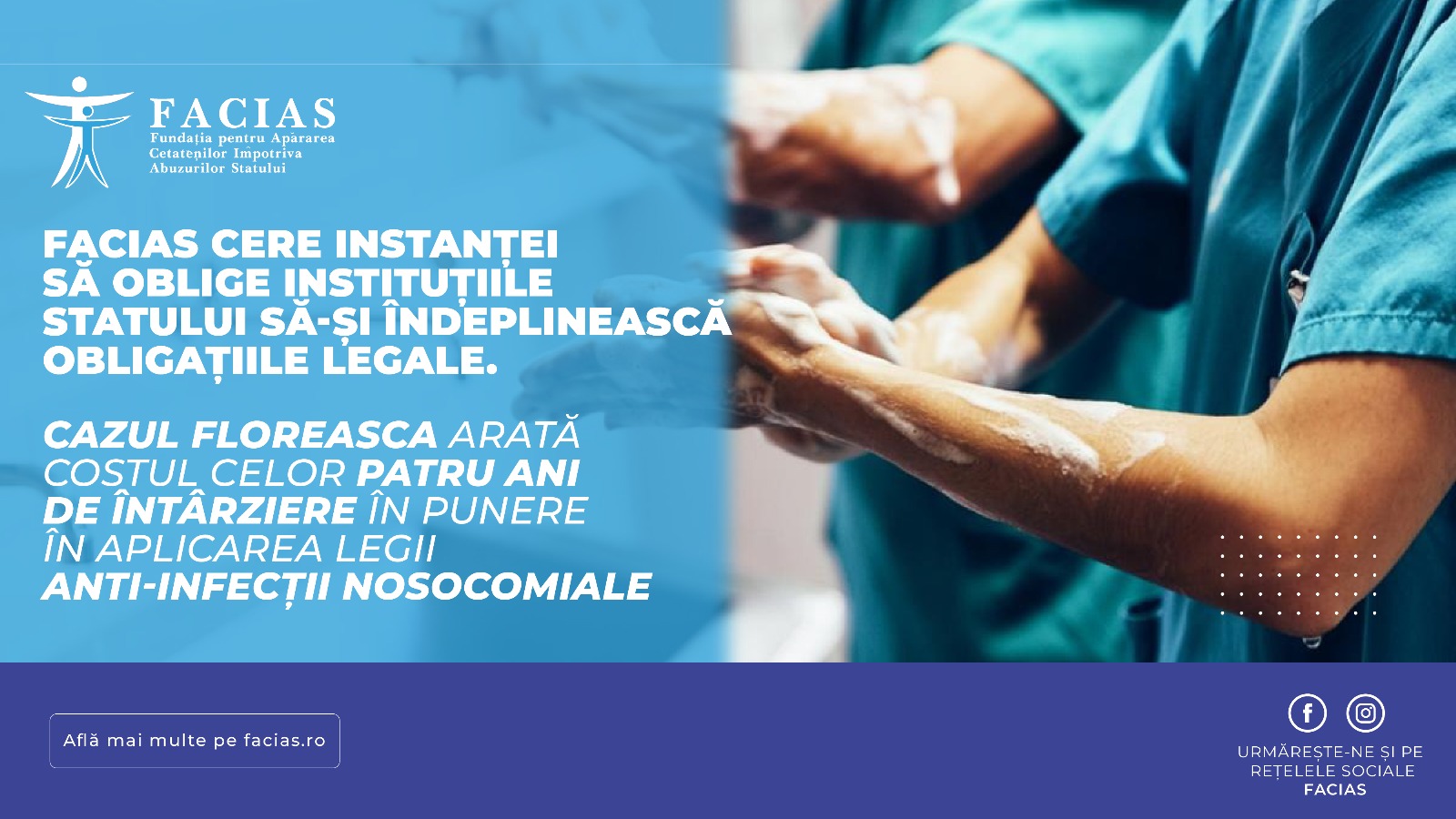
Cases of nosocomial infections are on the rise in Romanian hospitals, causing drama for families who are left to fight alone. Meanwhile, the state has been blocking the adoption of regulations to implement the law that was supposed to prevent the spread of nosocomial infections in medical institutions for four years. The Foundation For The Defense Of Citizens Against State Abuses (FACIAS) warns that if the methodological norms of Law No. 3/2021 had been adopted on time, hospitals would have been required to implement strict and uniform procedures, significantly reducing the risk of such outbreaks occurring and spreading.
FACIAS sued the Government and asked the court to order the executive to adopt, without delay, the decision necessary to implement Law No. 3/2021.
The most recent outbreak confirmed at the Bucharest Emergency Clinical Hospital's Center for Burn Victims, involving the presence of the multi-resistant fungus Candida auris, demonstrates the danger of this legislative vacuum. Back in December 2024, the Bucharest Emergency Clinical Hospital confirmed the presence of fungus Candida auris in a patient who, according to information in the media, later died. A report by the State Sanitary Inspection, carried out following an inspection at the end of July 2025, found serious deficiencies in this medical facility, including the failure to record infections in medical documents and the lack of dedicated spaces for the proper disinfection of instruments and equipment used to transport patients.
Predictably, ignoring these problems led to an escalation of the crisis. On August 1, 2025, quarantine was imposed at the Bucharest Emergency Clinical Hospital after the presence of the fungus Candida auriswas confirmed again, along with infections with the Pseudomonas aeruginosa bacterium. FACIAS warns that if the methodological norms of Law No. 3/2021 had been adopted in time, the hospital would have been obliged to implement strict and uniform procedures, significantly reducing the risk of the emergence and spread of such an outbreak.
The outbreaks in Floreasca are unfortunately not an isolated case, but a symptom of a systemic problem. In stark contrast to the European Union average of 7%, Romania has officially reported an incidence of only 1% of nosocomial infections in the last year. FACIAS emphasizes that this major discrepancy does not reflect the performance of the Romanian healthcare system, but rather chronic and dangerous underreporting that makes it impossible to take effective measures to stop the spread of infection.
For years, FACIAS has been asking the government and the Ministry of Health to adopt without delay the decision necessary to implement Law No. 3/2021. In order to expedite the adoption of the regulations, FACIAS appealed to the court and asked the judges to compel state institutions to adopt the methodological regulations of the law that should prevent nosocomial infections. The next hearing in this case has been set for October 21, 2025.