

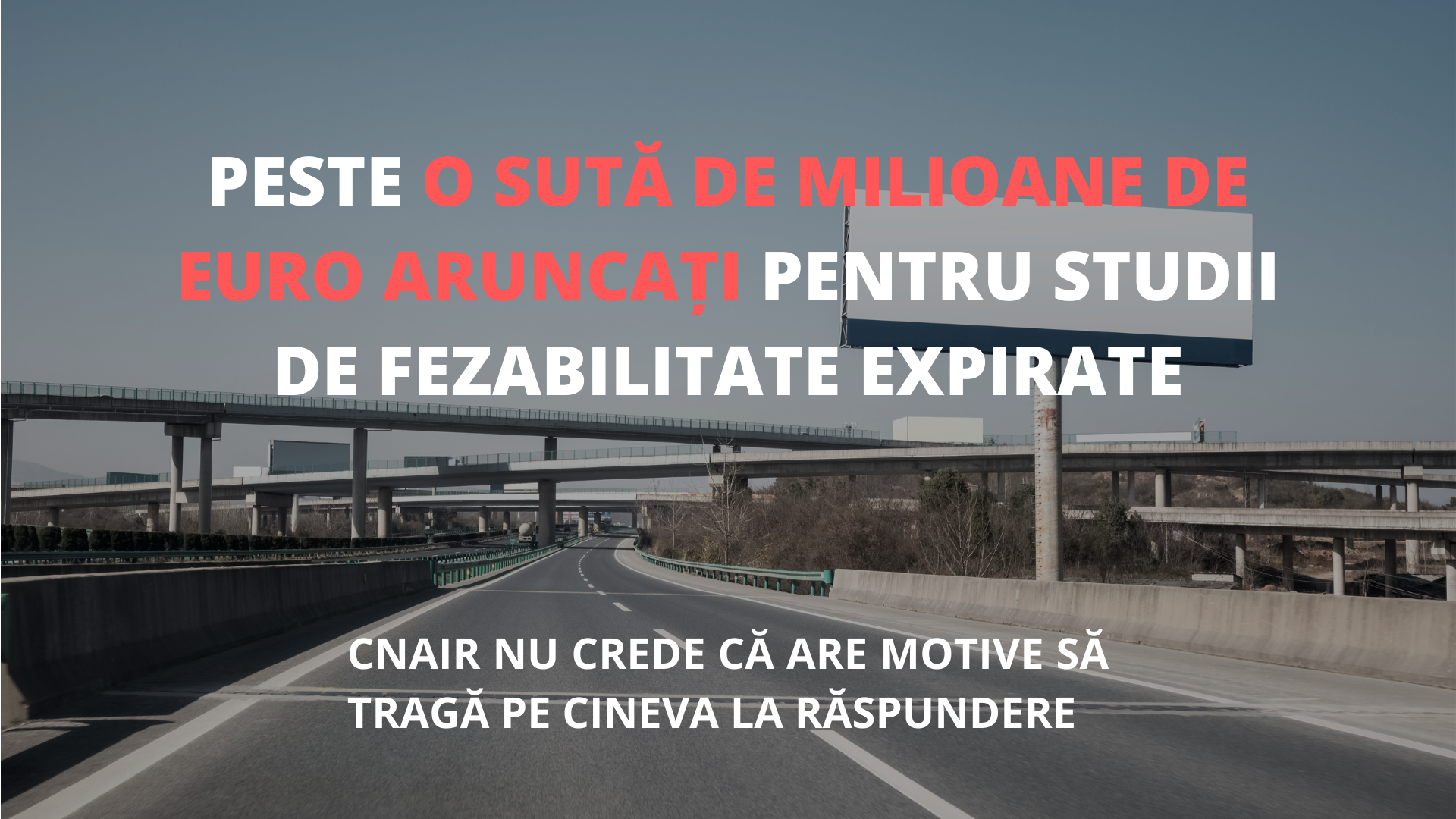
The Foundation for the Defense of Citizens Against State Abuses (FACIAS) draws attention to the large sums spent by the Romanian state through CNAIR on futile feasibility studies. The documentation was either expired or incorrect due to non-compliance with technical parameters, or contained errors. Tens of millions of lei have been wasted in certain instances for completing, amending, or rewriting feasibility studies.
In this regard, the Sibiu-Sebeș roadway has been the subject of multiple expired feasibility studies. In this situation, CNAIR auctioned the highway repair work on a regular basis. Other state-funded highway feasibility studies that have expired include: Sibiu - Pitești; Sibiu - Făgăraş; Târgu Mureș - Ditrău; Ditrău - Târgu Neamț; Târgu Neamţ - Iași - Ungheni; and the Bucharest North Ring Road (highway standard).
In legal terms, these actions can be considered intellectual forgery and use of forgery offenses, with losses totaling hundreds of millions of lei for the Romanian state. The costs are entirely paid for by citizens who will not profit from these roads. CNAIR, on the other hand, does not perceive in this manner. In response to FACIAS inquiries, the corporation states that, following the control measures, no damage to the national budget could be proved, and that there are no individuals held responsible or measures that may be enforced. Therefore, the roads and highways that exist only on paperwork do not represent a loss for the Romanian state, despite the fact that they transpose in massive sums for feasibility studies on numerous occasions.
The sums allocated to the state to determine if the construction is necessary are frequently enormous, depending on the type of road to be constructed. For instance, according to the CNAIR response:
- Last year, CNAIR spent 18,174,952 lei for the completion of the feasibility study for the Brasov-Făgăraş highway, and the project is now focused on determining the highway route.
- In the case of the Tg. Mures - Tg. Neamţ, 17,580,355 lei were allotted in 2019 to finish the feasibility study, which is still ongoing.
- Last year, the amount authorized for the Tg. Neamţ - Iaşi - Ungheni highway was 58,830,448 lei, also for the completion of the study.
- Last year, there was another addition cost 46,554,284 lei for the feasibility study of the Ploiesti-Braşov highway section.
- The feasibility study for the Iasi city ring road was revised for 1,359,277 lei, and another study for the Vaslui city ring road was revised for 1,478,500 lei.
- In 2017, 132,157 lei were spent on a pre-feasibility study for the Drajna passage KM 105+500, which is a 2.74 km segment, and then another 431,977 lei were spent on a feasibility study two years later.
- The Cluj Regional Directorate of Roads and Bridges spent 2.8 million lei on feasibility studies for DN17C and DN17D restoration. Essentially, the state paid considerable sums to be advised that two existing highways should be renovated.
- In 2019, 1,698,599 lei were paid to complete a feasibility study for the bypass of Reghin city. According to CNAIR's reaction, three years after this payment, the issuance of the Government Decision for the approval of the technical indicators is still economically pending.
- In Iasi, CNAIR paid a business 390,000 lei to conduct a feasibility study to determine whether a bridge should be strengthened.
More information on the feasibility studies funded by CNAIR in recent years can be found on the FACIASin the section dedicated to the "Turn off the waste tap!" campaign.
FACIAS, according to its statutory purpose, but also through its constant activity over the past 14 years, defends the rights of citizens and seeks to ensure transparency in the functioning of state institutions as a principle of democracy and the rule of law.