

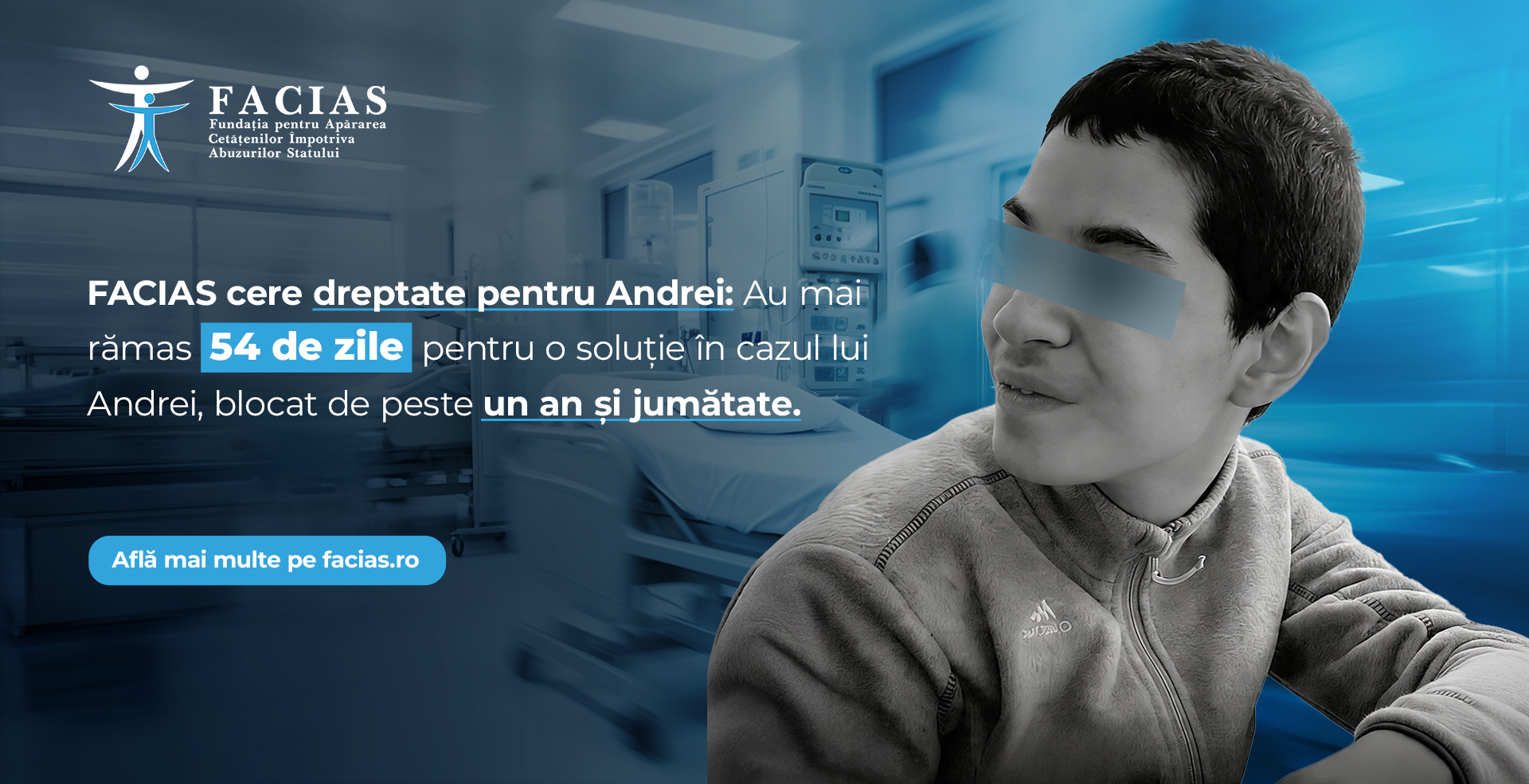
The justice clock is ticking: there are only 54 days left until the court-imposed deadline to complete the investigation into the case of Andrei Drăgan – the teenager who died in Târgu-Jiu. In all this time, an essential piece of the file is missing: the supplement to the forensic medical examination.
The case of Andrei Drăgan, the 16-year-old teenager who died in November 2024 at the Târgu-Jiu County Emergency Hospital, continues to be marred by inexplicable delays. Although the Târgu-Jiu Court has set the 30th of June, 2026 as the deadline for completing the criminal investigation, the file is still incomplete.
The Foundation for the Defence of Citizens Against State Abuses (FACIAS) is sounding a new alarm, officially requesting clarifications from both the Prosecutor's Office attached to the Gorj Court of Law and the Gorj County Forensic Medicine Service, regarding the status of the forensic expertise, a new pretext for delays in this case.
According to the analysed documents, objections to the forensic medical report were formulated as early as September 2025. Since then, a supplement to the expertise has been requested, but it has not been completed to this day. Moreover, almost a year has passed since the report was requested to be completed, but the authorities provided no clear deadline for the completion or any actual explanations for the delay.
FACIAS demands the immediate submission of the supplement to the expertise and the establishment by the authorities of the persons responsible for the delay, as well as whether there are any administrative or financial bottlenecks that led to this situation. FACIAS also requests essential information on the expertise procedure: whether an expert has been appointed, whether the fee has been established and paid, and what are the real reasons why this evidence is not completed. In parallel, the Forensic Medicine Service is called upon to communicate a deadline for the completion and transmission of the supplement to the Prosecutor's Office, given that this delay directly affects the course of the investigation, which began 1 year and 6 months ago.
The situation is all the more serious as the court has already found that the duration of the investigation is excessive and has imposed a deadline for the completion of the procedures. However, in the absence of expertise, this deadline risks becoming impossible to meet. FACIAS warns that delaying essential evidence is not only a procedural problem, but a major vulnerability of the justice system, with a direct impact on the right to a fair trial and on public trust.
At the centre of this deadlock is a case that shocked public opinion: the death of a teenager in a hospital from an ordinary appendicitis, after doctors refused to perform surgery. Today, more than a year and a half after the tragedy, the perpetrators are still at large, and a case similar to the one of Andrei could occur again at any time.
There are 54 days left. Not just until a procedural deadline, but until a credibility test for the entire system. And the question remains: will the state manage to deliver justice on time or will it commit another abuse in this case?