

Content
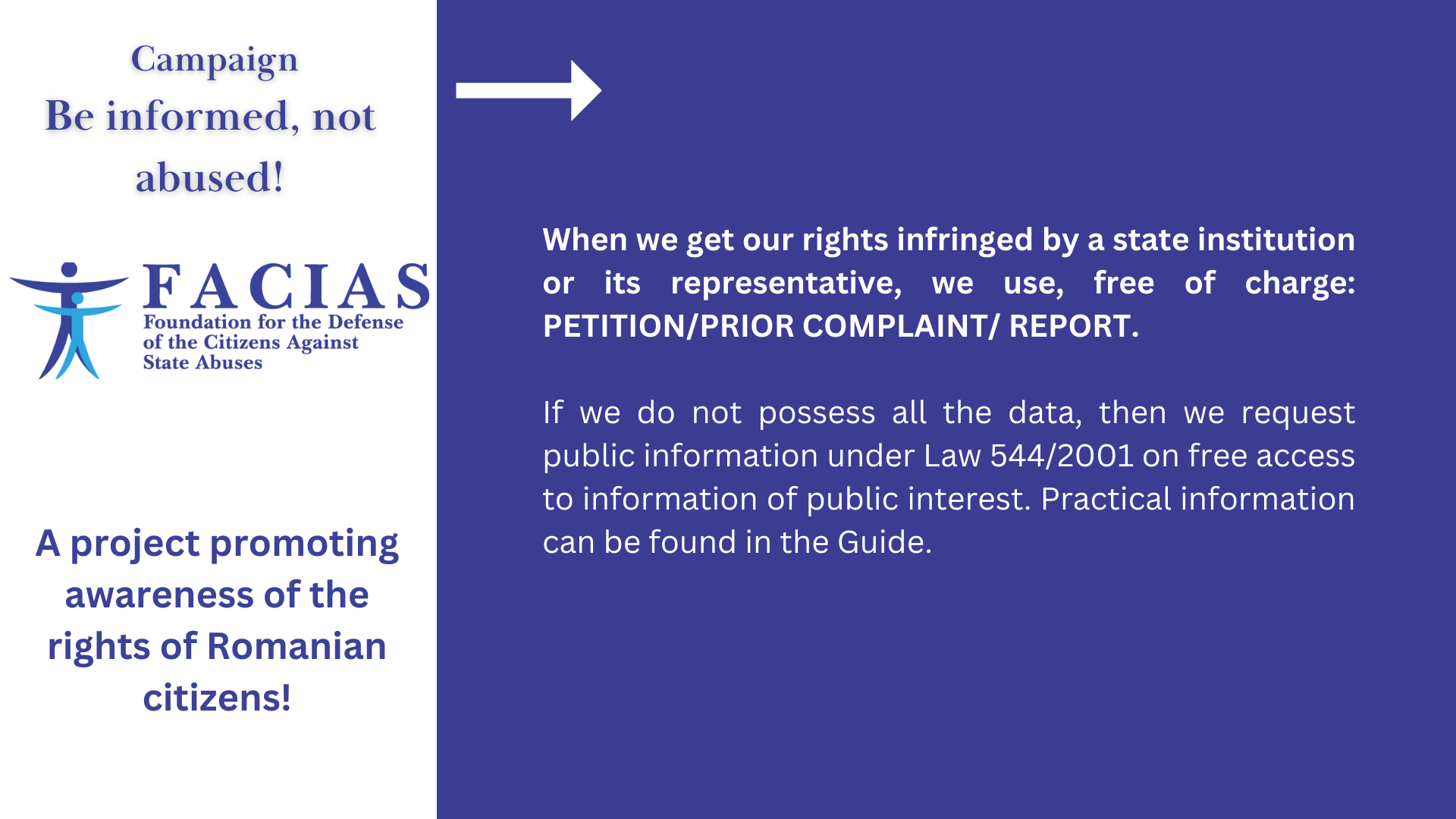
1. Law 544/2001 enables us to get information of public interest from state entities in order to prevent or counteract abuse.
2. The government institution required by law to supply us with public information of importance to us.
3. What should we do if the institution refuses to respond?
4. Request for public information - model
We learned from earlier materials of the FACIAS Guide, created as your support in relation to state institutions:
- How do we, as citizens, recognize that we are dealing with an abuse;
- Minimum criteria for identifying an abusive situation;
- Access to justice is guaranteed by law through the courts;
- How may we obtain justice at no cost: THE PETITION, THE COMPLAINT, AND THE REPORT;
In this post, we will discuss how to obtain the public information we require in our efforts to get justice before appearing before a judge. We still have tools that we can employ in the absence of courts or specialized legal services.
1. LAW 544/2001 ASSISTS US IN ACQUIRING INFORMATION OF PUBLIC INTEREST, USEFUL FOR PROVING / FIGHTING ABUSE
We employ PRIOR COMPLAINT when an injustice affects us individually or as a society. We can obviously utilize this instrument at any time, whether or not we are victims of abuse (individual or collective), but we are specifically interested in what we must do in the case of abuse done by a governmental institution.
As a result, we may not have all of the information we require in our quest. We require public information.
According to Article 5 of Law 544/2001, public institutions will, in general, disclose this information on their website, in designated areas titled "Information of Public Interest" or "Transparency." We assume that we have searched for the information we require to proceed, but it is not available on the institution's website. In this case, we are pursuing our interest through the application of Law 544/2001 on open access to information of public interest.
We will send the request to the public institution[1], but we will be cautious to state that it is based on the law of Law 544/2001 on free access to information of public interest, as well as to clearly request what we want to know.
It is vital to understand what public information is in order to resolve our request. Any information concerning or resulting from the operations of a public authority/institution is considered information of public interest.[2]
It is critical that we do not request personal information because doing so will result in our request being refused under the GDPR[3]. We must not request personal data, that is, data relating to a recognized or identifiable natural person (name, telephone number, etc.).
2. The government institution required by law to supply us with public information of importance to us.
Public authorities and institutions are required to answer to our request in writing within 10 days, or within 30 days at most, from the time the request is registered, if the information is complex and necessitates a significant volume of effort and paperwork.
If the institution declines to respond to our request, it must notify us within 5 days of receiving it. The institution is also required to explain why it is refusing to deliver an answer. Most of the time, we are denied because we sought information that is not publicly available or data that is considered personal. However, there are times when we are not replied to, or are told that our request is not subject to Law 544/2001, which is why it is evidently important to know if the refusal received is based on reality, or just a motive to ignore the law.
Once we have collected the data we require for achieving justice, we utilize the information in our activities: petition, prior complaint, and so on, but we must be mindful of the time constraints and correlate them.
3. What should we do if the institution refuses to respond?
What should we do if a government agency refuses to provide us with the desired information? Refusal is considered misbehavior and the guilty party faces disciplinary action. We can file a complaint [4] (petition) against the refusal within 30 days of being informed that we will not get the public information.
The institution iwill be conducting administrative research to determine why we have not received a response. If the administrative investigation determines that we were refused access in an unreasonable manner, the institution will supply us with all responses within 15 days of our complaint. On that day, we will also learn about the disciplinary actions taken by the institution against those who refused to answer our questions.
If we did not obtain the requested public information this time either, then we file a complaint with the administrative litigation section of the court within the radius of which we live or the institution in question operates. We file a complaint within 30 days from the date of expiry of the stipulated period (the 5-day period in which the institution informs us that it will not respond and gives reasons for it).
But we will stop here because we have decided that at this moment, we will only discuss what we can do to obtain justice without resorting to lawsuits and attorneys.
4.Model orientativ solicitare informații publice
FACIAS developed a sample Request for Access to Public Information (download the complaint in PDF format, download the complaint in Word format):
Skip to PDF contentEXTRA INFORMATION:
Next week's article will explain how we can use the information obtained under Law 544/2001, how we can associate when there are more individuals affected by a state institution's abuse, and how we can use Law no. 52/2003 on decision-making transparency in public administration, and how much collective online petitions can help us:
[1] Art 2, Art 2, Law 544.2001: "authority or public institution means any authority or public institution that uses or administers public financial resources, any autonomous management, company regulated by the Companies Law no. 31/1990, republished, with subsequent amendments and additions, under the authority or, as the case may be, in the coordination or subordination of a central or local public authority and in which the Romanian state or, as the case may be, an administrative-territorial unit is the sole shareholder or majority, as well as any operator or regional operator, as they are defined in the Law on community services of public utilities no. 51/2006, republished, with subsequent amendments and additions. Political parties, sports federations and non-governmental organizations of public utility, which benefit from funding from public money, are also subject to the provisions of this law;"
[2] Art 5 - Law 544/2001: http://legislatie.just.ro/Public/DetaliiDocument/31413
[3] To learn more about personal data protection, we can read Law No. 363 of December 28, 2018 regarding the protection of natural persons regarding the processing of personal data by competent authorities for the purposes of prevention, discovery, investigation, prosecution, and combating of crimes or the execution of punishments, educational and safety measures, and the free movement of these data, which is freely available at: http://legislatie.just.ro/Public/DetaliiDocument/209627
[4] We have already discussed these tools, previously, in the Guide.