

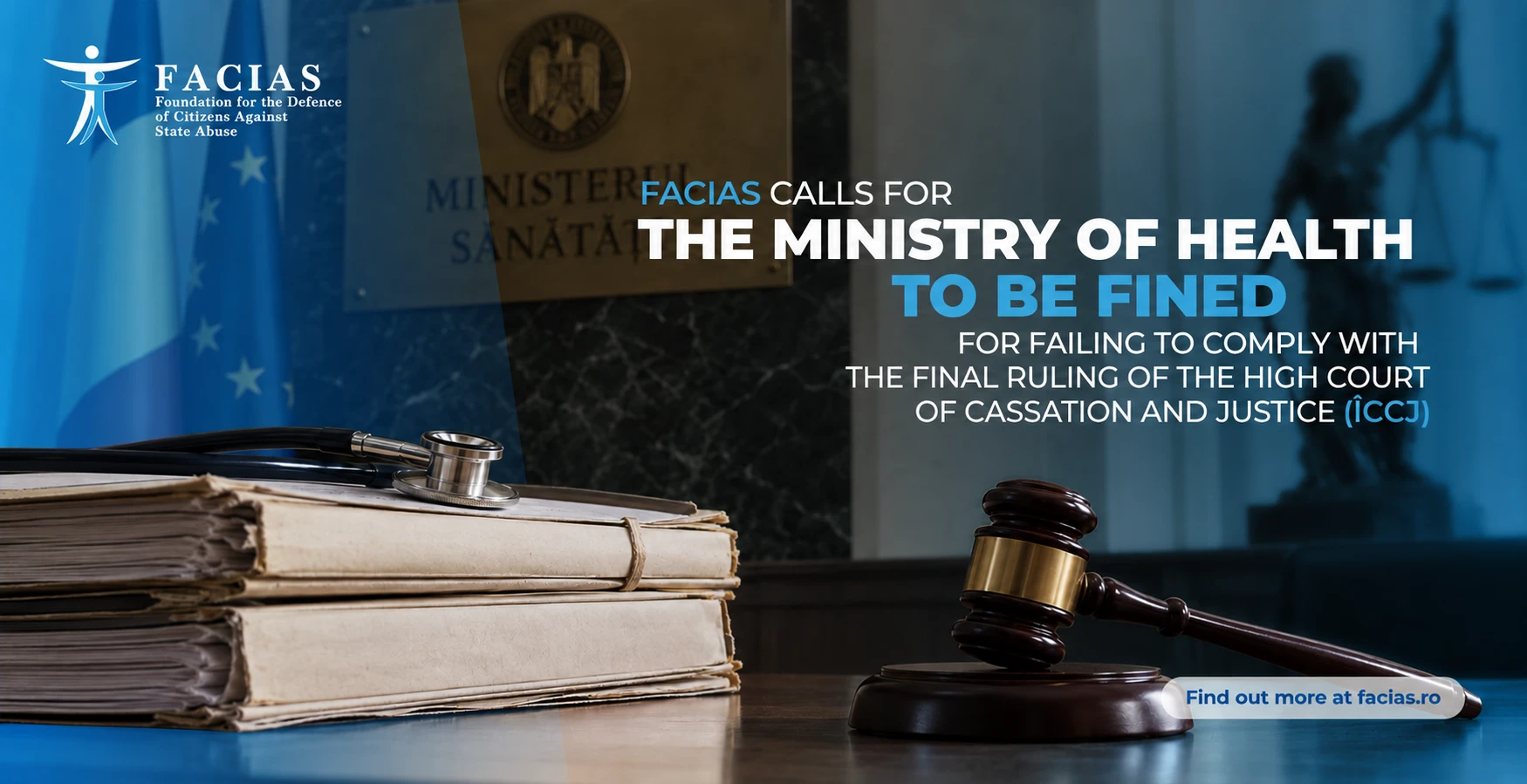
The Foundation for the Defence of Citizens Against State Abuses has requested the Bucharest Court of Appeal to initiate enforcement proceedings against the Ministry of Health, which has not yet implemented the final decision of the High Court by which it was obliged to issue the norms for the Law on Complementary and Alternative Medicine. The first hearing date in file no. 4546/2/2026 is set for Monday, the 14th of September, 2026.
In March 2025, the High Court of Cassation and Justice ruled in favour of FACIAS and ordered the Ministry of Health to develop and approve, by order, the methodological norms for the application of Law no. 118/2007 on the organization and functioning of complementary/alternative medicine activities and practices. The civil decision of the High Court of Cassation and Justice is an enforceable title, and the ministry had a maximum of 30 days to execute the decision. The legal deadline expired in April 2025, but the ministry has not developed and approved the norms even after more than a year and five months after that date.
As the formal notices remained ineffective, FACIAS initiated the special enforcement procedure as provided for under the Administrative Litigation Law. FACIAS requests the court to impose a fine of 20% of the gross minimum wage per economy for each day of delay, to oblige the Ministry of Health to pay daily penalties, under the terms of art. 24 of Law no. 554/2004, and to pay court costs.
The failure to enforce the Supreme Court’s decision prolongs an administrative deadlock that has, in reality, lasted for almost two decades. 19 years ago, the Romanian Parliament adopted Law no. 118/2007 to regulate the organization and functioning of complementary and alternative medicine activities and practices. The law refers to practices such as acupuncture, phytotherapy, apitherapy, homeopathy, chiropractic, osteopathy and traditional oriental medicine. It also requires practitioners to keep records of patients, obtain their written consent, ensure the confidentiality of medical data and provide accurate information on the benefits and risks of the interventions to which patients submit.
The Ministry of Health was supposed to issue the methodological norms within one year of the publication of the law, but the deadline expired in May 2008 without this obligation being fulfilled. In the absence of implementing norms, FACIAS repeatedly requested the institution to fulfil its legal obligation. Because the norms were never issued, in 2023, FACIAS took the ministry to court, obtaining the final decision of the High Court in March 2025.
The consequences of this abusive refusal of the Ministry of Health to develop implementing rules directly affect the safety and budget of citizens. Thus, for years, in Romania there has been no functional legal framework that would precisely establish who can provide these alternative and complementary medicine services, under what conditions they can be provided, with what responsibilities and under what forms of control. The lack of these rules makes it impossible, in practice, to hold accountable those who commit errors or abuses.
In its application to the court, FACIAS emphasizes that issuing the rules does not equate to the automatic validation of any therapy or the immediate settlement of all services mentioned by law. Such a framework would, on the other hand, allow patients to know clearly whether the service they are using is authorized, what training the person providing it has, what risks it entails and what costs they will have to bear. The adoption of this regulatory framework offers greater protection both for the health and safety of patients, and for the financial decisions they make.
FACIAS will continue the legal proceedings until the publication of the ministerial order on the implementation of the complementary and alternative medicine law, emphasizing that the state's failure to enforce a final decision of the High Court is an abuse that nullifies the principles of the rule of law.